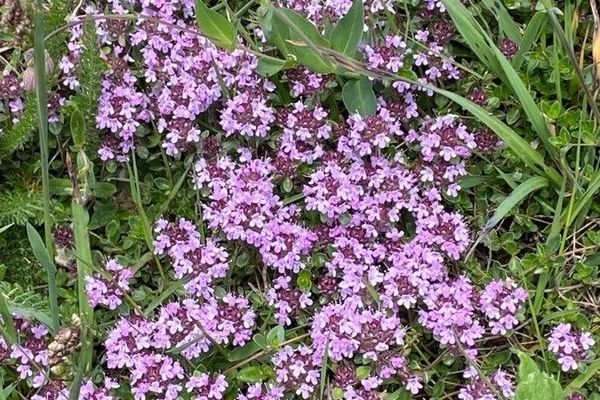
Breckland thyme
Thymus serpyllum
Родина: Lamiaceae • Рід: Thymus
БагаторічнаСередньоДекоративна
Wild Thyme (T. serpyllum) tolerates light treading and grows well between stepping stones on paths and in walls. Leaves are used raw in salads or added as a flavouring to cooked foods. Bloom Color: Purple. Main Bloom Time: Early summer. Form: Prostrate, Spreading or horizontal.
Опис
Requires a light well-drained preferably calcareous soil in a sunny position[1, 200]. Succeeds in dry soils. Grows well between stepping stones on paths, tolerating light treading[183, 200]. Succeeds on walls. Thymes dislike wet conditions, especially in the winter. A layer of gravel on the soil around them will help protect the foliage from wet soils. Plants are hardy to about -15°c. This is a very difficult genus taxonomically, the species hybridize freely with each other and often intergrade into each other. This species is harvested commercially for its essential oil, known as 'wild thyme'. Closely related to T. praecox arcticus, but this species is not so common in Britain. It is a very polymorphic plant. A good companion for most other plants, it makes a very good carpeting plant for the rockery or between paving stones and can also be grown in a short lawn. The flowers are rich in nectar and are very attractive to honey bees, the plant also attracts butterflies[4, 7, 24]. Special Features:Attractive foliage, Edible, Fragrant foliage, Not North American native, Suitable for dried flowers. Heat Zone 9-1. Thyme is typically harvested in late spring to early summer, just before the plant flowers for the best flavor. Thyme usually flowers in late spring to early summer, generally from June to August (Northern Hemisphere). Thyme is considered a slow to moderate grower, reaching maturity in about 1 to 2 years under optimal conditions. References Carbon Farming Information and Carbon Sequestration Information Temperature Converter Type a value in the Celsius field to convert the value to Fahrenheit: Celsius Fahrenheit: The PFAF Bookshop Plants For A Future have a number of books available in paperback and digital form. Book titles include Edible Plants , Edible Perennials , Edible Trees , Edible Shrubs , Woodland Gardening , and Temperate Food Forest Plants . Our new book is Food Forest Plants For Hotter Conditions (Tropical and Sub-Tropical) . Shop Now
Походження та ареал
TEMPERATE ASIA: Russian Federation-Western Siberia (Western Siberia), Russian Federation-Eastern Siberia (Eastern Siberia (Dauria)) EUROPE: Denmark, Finland, United Kingdom, Norway, Sweden, Czechoslovakia, Austria (north), Belgium, Germany, Hungary, Netherlands, Poland, Russian Federation (European part), Belarus, Estonia, Lithuania, Latvia, Ukraine (north), Former Yugoslavia (north), France (northeast)
Корисні властивості
Edible Parts: Leaves Edible Uses: Tea Leaves - raw in salads or added as a flavouring to cooked foods[2, 11, 46, 61]. Thyme retains its flavour well in long slow cooking. If the leaves are to be dried, the plants should be harvested in early and late summer just before the flowers open and the leaves should be dried quickly. An aromatic tea is made from the leaves. References More on Edible Uses
Поради
Seed - sow spring in a cold frame. Seed can also be sown in autumn in a greenhouse. Surface sow or barely cover the seed. Germination can be erratic. When they are large enough to handle, prick the seedlings out into individual pots and grow them on in the greenhouse for at least their first winter. Plant them out into their permanent positions in late spring or early summer, after the last expected frosts. Division in spring or autumn. Larger divisions can be planted out direct into their permanent positions. We have found that it is best to pot up smaller divisions and grow them on in light shade in a greenhouse or cold frame until they are growing away well. Plant them out in the summer or the following spring. Cuttings of young shoots, 5 - 8cm with a heel, May/June in a frame. Cuttings of half-ripe wood, 5 - 8cm with a heel, July/August in a frame. Layering.