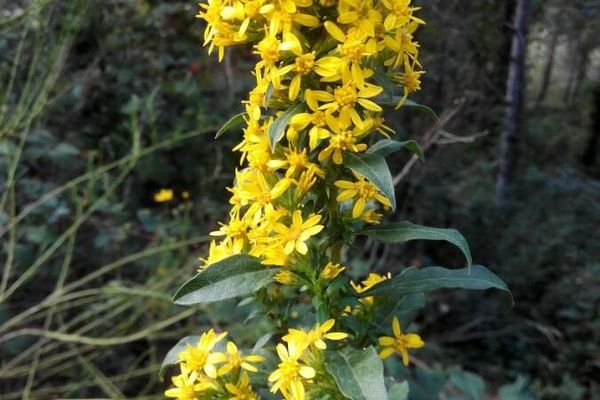
European goldenrod
Solidago virgaurea
Родина: Asteraceae • Рід: Solidago
БагаторічнаСередньоДекоративна
вид рослин
Опис
An easily grown plant, it succeeds in any moderately fertile moisture retentive soil in sun or semi-shade. Grows well in heavy clay soils. A rather greedy plant, it is apt to impoverish the soil. The bruised plant smells like wild carrots. The sub-species S. virgaurea minuta is only 10cm tall and wide. The plant attracts various beneficial insects such as ladybirds, lacewings and hoverflies to the garden, these insects will help to control insect pests in the garden[201, 238]. References Carbon Farming Information and Carbon Sequestration Information Temperature Converter Type a value in the Celsius field to convert the value to Fahrenheit: Celsius Fahrenheit: The PFAF Bookshop Plants For A Future have a number of books available in paperback and digital form. Book titles include Edible Plants , Edible Perennials , Edible Trees , Edible Shrubs , Woodland Gardening , and Temperate Food Forest Plants . Our new book is Food Forest Plants For Hotter Conditions (Tropical and Sub-Tropical) . Shop Now
Походження та ареал
TEMPERATE ASIA: Afghanistan, Iran, Syria, Turkey, Russian Federation-Ciscaucasia (Ciscaucasia), Azerbaijan, Georgia, Russian Federation (Dagestan), Russian Federation-Western Siberia (Western Siberia), Russian Federation-Eastern Siberia (Eastern Siberia), Russian Federation (Altay), Kazakhstan, Kyrgyzstan, Tajikistan, Russian Federation-Far East (Far East), Russian Federation (Kurile Islands) TROPICAL ASIA: India (north), Nepal, Pakistan (north) EUROPE: Denmark, Finland, United Kingdom, Ireland,
Корисні властивості
Edible Parts: Edible Uses: Tea A tea is obtained from the leaves[46, 61, 183]. References More on Edible Uses
Поради
Seed - sow spring in a cold frame. Only just cover the seed and do not allow the compost to become dry. Prick out the seedlings into individual pots when they are large enough to handle, and grow them on for their first winter in pots. Plant them out into their permanent positions in spring or early summer. Division in spring or autumn. Larger divisions can be planted out direct into their permanent positions. We have found it best to pot up the smaller divisions and grow them on in a lightly shaded position in a cold frame, planting them out once they are well established in the summer.