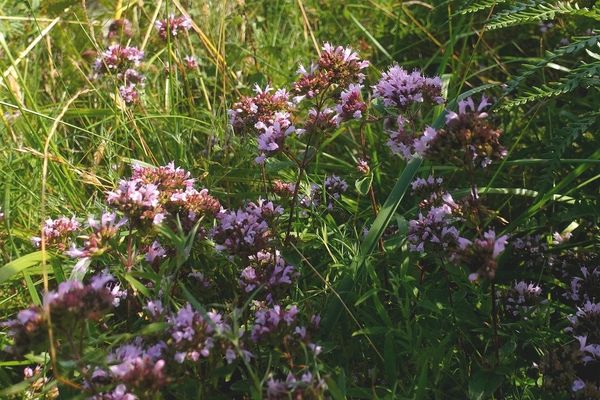
Wild marjoram
Origanum vulgare
Родина: Lamiaceae • Рід: Origanum
БагаторічнаСередньоДекоративна
Bloom Color: Pink, White. Main Bloom Time: Late Spring, Early Summer, Late summer, Midsummer. Form: Spreading or horizontal.
Опис
Landscape Uses:Border, Container, Ground cover, Rock garden, Seashore. Requires a rather dry, warm, well-drained soil in full sun, but is not fussy as to soil type, thriving on chalk[1, 27]. Prefers slightly alkaline conditions. Tolerates poor soils. Dislikes wet soils. Hardy to about -20°c. Oregano has a long history of culinary and medicinal use and is often cultivated in modern gardens as a culinary herb, there are some named varieties[183, 187, 238, 244]. Plants growing near the sea have the most fragrance. A good companion plant, improving the flavour of nearby plants. The flowers are very attractive to bees and butterflies[5, 30]. A good companion for the cucumber family, it is beneficial to all nearby plants. The whole plant has a sweet yet slightly peppery aroma. Members of this genus are rarely if ever troubled by browsing deer. Special Features: Attractive foliage, Fragrant foliage, Not North American native, Attracts butterflies, Suitable for cut flowers, Suitable for dried flowers, Fragrant flowers. In garden design, as well as the above-ground architecture of a plant, root structure considerations help in choosing plants that work together for their optimal soil requirements including nutrients and water. The root pattern is rhizomatous with underground stems sending roots and shoots along their length [2-1]. Oregano is self-fertile. Oregano is typically harvested in late spring to summer, just before the plant begins to flower. Oregano generally flowers from mid-summer to early autumn. Oregano grows relatively quickly, reaching maturity in about 2-3 months under optimal conditions. References Carbon Farming Information and Carbon Sequestration Information Temperature Converter Type a value in the Celsius field to convert the value to Fahrenheit: Celsius Fahrenheit: The PFAF Bookshop Plants For A Future have a number of books available in paperback and digital form. Book titles include Edible Plants , Edible Perennials , Edible Trees , Edible Shrubs , Woodland Gardening , and Temperate Food Forest Plants . Our new book is Food Forest Plants For Hotter Conditions (Tropical and Sub-Tropical) . Shop Now
Походження та ареал
TEMPERATE ASIA: Anhui Sheng, Armenia, Azerbaijan, China, Ciscaucasia, Cyprus, Dagestan, Eastern Siberia, Fujian Sheng, Gansu Sheng, Georgia, Guangdong Sheng, Guizhou Sheng, Henan Sheng, Hubei Sheng, Hunan Sheng, Iran, Iraq, Jiangsu Sheng, Jiangxi Sheng, Kazakhstan, Kyrgyzstan, Russian Federation, Russian Federation-Ciscaucasia, Russian Federation-Eastern Siberia, Russian Federation-Western Siberia, Shaanxi Sheng, Sichuan Sheng, Taiwan, Turkey, Western Siberia, Xinjiang Uygur Zizhiqu, Yunnan Shen
Корисні властивості
Edible Parts: Flowers Leaves Stem Edible Uses: Condiment Tea Leaves - raw or cooked as a potherb[5, 52, 183]. Oregano is an important flavouring herb in Mediterranean cookery, and is often used dried rather than fresh. The leaves are used as a flavouring for salad dressings, vegetables and legumes, and are frequently included in strongly flavoured dishes with chillies, garlic, onions etc[2, 13, 21, 27, 183, 238]. A nutritional analysis is available. Flowers, usually appear in late spring, are edible. Much of the commercially available dried oregano does not come from this plant but from a number of different, often unrelated plants. These include Lippia graveolens, L. palmeri and Origanum syriacum. A herb tea is made from the dried leaves and flowering stems[183, 207, 238]. References More on Edible Uses Composition Figures in grams (g) or miligrams (mg) per 100g of food. Leaves (Dry weight) 306 Calories per 100g Water : 7.2% Protein: 11g; Fat: 10.2g; Carbohydrate: 64.4g; Fibre: 15g; Ash: 7.2g; Minerals - Calcium: 1576mg; Phosphorus: 200mg; Iron: 44mg; Magnesium: 270mg; Sodium: 15mg; Potassium: 1669mg; Zinc: 4.4mg; Vitamins - A: 6903mg; Thiamine (B1): 0.34mg; Riboflavin (B2): 0mg; Niacin: 6.2mg; B6: 0mg; C: 0mg; Reference: [ 218] Notes:
Поради
Seed - sow early spring at 10 - 13°c and only just cover the seed. Germination usually takes place within 2 weeks. Prick out the seedlings into individual pots when they are large enough to handle and plant them out into their permanent positions in early summer. The seed can also be sown in situ in late spring. Division in March or October. Very easy, larger divisions can be planted out direct into their permanent positions. We have found that it is better to pot up the smaller divisions and grow them on in light shade in a cold frame until they are well established before planting them out in late spring or early summer. Basal cuttings of young barren shoots in June. Very easy. Harvest the shoots with plenty of underground stem when they are about 8 - 10cm above the ground. Pot them up into individual pots and keep them in light shade in a cold frame or greenhouse until they are rooting well. Plant them out in the summer.