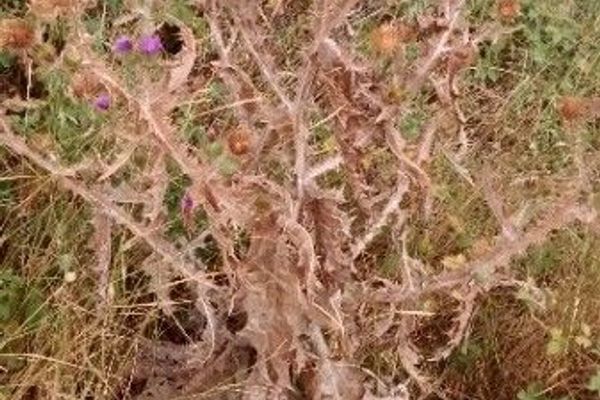
Cotton thistle
Onopordum acanthium
Родина: Asteraceae • Рід: Onopordum
БагаторічнаСередньоДекоративна
Опис
An easily grown plant, it succeeds in almost any ordinary garden soil[1, 111]. Requires a well-drained soil, preferably in full sun though it tolerates light shade. Prefers a slightly alkaline soil. Grows very well in poor soils, succeeding in hot dry situations and tolerating drought when it is established. A slow-growing plant. Hardy to about -15°c. A very ornamental plant, the flowers are very attractive to bees. Plants are prone to slug and snail damage. Often self-sows, sometimes to the point of nuisance, though the seedlings can easily be hoed out and can also be transplanted if they are moved whilst still small. References Carbon Farming Information and Carbon Sequestration Information Temperature Converter Type a value in the Celsius field to convert the value to Fahrenheit: Celsius Fahrenheit: The PFAF Bookshop Plants For A Future have a number of books available in paperback and digital form. Book titles include Edible Plants , Edible Perennials , Edible Trees , Edible Shrubs , Woodland Gardening , and Temperate Food Forest Plants . Our new book is Food Forest Plants For Hotter Conditions (Tropical and Sub-Tropical) . Shop Now
Походження та ареал
TEMPERATE ASIA: Afghanistan, Iran, Iraq (north), Turkey, Russian Federation-Ciscaucasia (Ciscaucasia), Armenia, Azerbaijan, Georgia, Russian Federation (Dagestan), Kazakhstan, Kyrgyzstan, Tajikistan, Turkmenistan, Uzbekistan, China (Xinjiang Uygur Zizhiqu (north)) TROPICAL ASIA: India (Jammu and Kashmir), Pakistan (north) EUROPE: Austria, Switzerland, Czech Republic, Germany, Hungary, Netherlands, Slovakia, Belarus, Moldova, Ukraine (incl. Krym), Albania, Bulgaria, Bosnia and Herzegovina, Greece
Корисні властивості
Edible Parts: Flowers Leaves Oil Oil Stem Edible Uses: Colouring Oil Oil Flower buds - cooked. A globe artichoke substitute[2, 4, 9, 115, 183], though they are much smaller and very fiddly to use[K]. Stems - cooked. Used as a vegetable, they are a cardoon (Cynara cardunculus) substitute[2, 4]. The stems are cooked in water like asparagus or rhubarb. They are best if the rind is removed[4, 115, 183]. Leaves and young plants - cooked[9, 105]. They are harvested before the flowers develop and the prickles must be removed prior to cooking. The petals are an adulterant for saffron[46, 61, 105, 183], used as a yellow food colouring and flavouring. A good quality edible oil is obtained from the seed[2, 4, 183]. The seed contains about 25% oil. References More on Edible Uses
Поради
Seed - sow spring in situ. The seed can also be sown in situ in autumn. If the seed is in short supply then it can be sown in a pot in the greenhouse in the spring. Prick out the seedlings into individual pots as soon as they are large enough to handle and plant them out into their permanent positions in early summer.