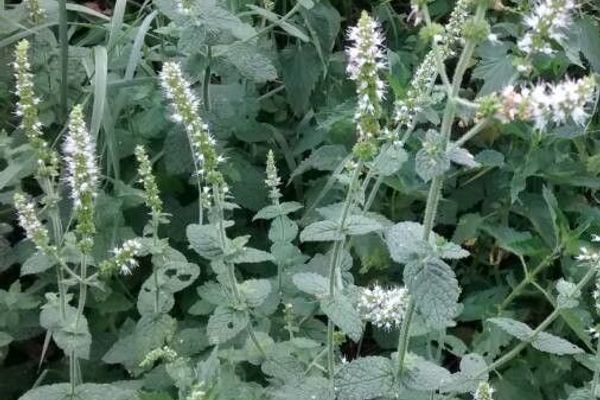
Опис
Landscape Uses:Border, Ground cover, Specimen. A very easily grown plant, it succeeds in most soils and situations so long as the soil is not too dry[1, 200]. Grows well in heavy clay soils. A sunny position is best for production of essential oils, but plants also succeed in partial shade. Often cultivated as a pot herb. There are some named varieties. The flowers have a sickly sweet smell. A very invasive plant, spreading freely at the roots. Unless you have the space to let it roam, it needs to be restrained by some means such as planting it in a container that is buried in the soil[K]. It is said to be a good companion for cabbages and tomatoes, its aromatic leaves repelling insect pests, though its aggressive root system also needs to be taken into account here. The whole plant has a mint-like aroma. The flowers are very attractive to bees and butterflies. Members of this genus are rarely if ever troubled by browsing deer. Hybridizes freely with other members of this genus. Special Features: Attractive foliage, Edible, Fragrant foliage, Not North American native, Invasive, Naturalizing, Suitable for cut flowers, Suitable for dried flowers. The plant is heat tolerant in zones 9 through 5. (Plant Hardiness Zones show how well plants withstand cold winter temperatures. Plant Heat Zones show when plants would start suffering from the heat. The Plant Heat Zone map is based on the number of "heat days" experienced in a given area where the temperature climbs to over 86 degrees F (30°C). At this temperature, many plants begin to suffer physiological damage. Heat Zones range from 1 (no heat days) to 12 (210 or more heat days). For example Heat Zone. 11-1 indicates that the plant is heat tolerant in zones 11 through 1.) For polyculture design as well as the above-ground architecture (form - tree, shrub etc. and size shown above) information on the habit and root pattern is also useful and given here if available. The plant growth habit is a runner spreading indefinitely by rhizomes or stolons [1-2]. The root pattern is rhizomatous with underground stems sending roots and shoots along their length [1-2]. The root pattern is stoloniferous rooting from creeping stems above the ground [1-2]. Mint leaves can be harvested throughout the growing season, from spring to autumn, but they are best harvested just before flowering for optimal flavor. Mint typically flowers from late spring to early summer. It is a fast-growing plant that often establishes itself quickly and spreads aggressively, making it suitable for quick ground cover in gardens. Mint species are generally self-fertile. References Carbon Farming Information and Carbon Sequestration Information Temperature Converter Type a value in the Celsius field to convert the value to Fahrenheit: Celsius Fahrenheit: The PFAF Bookshop Plants For A Future have a number of books available in paperback and digital form. Book titles include Edible Plants , Edible Perennials , Edible Trees , Edible Shrubs , Woodland Gardening , and Temperate Food Forest Plants . Our new book is Food Forest Plants For Hotter Conditions (Tropical and Sub-Tropical) . Shop Now
Походження та ареал
TEMPERATE ASIA: Turkey (west). EUROPE: United Kingdom (U.K.), Belgium, Switzerland, Germany, Netherlands, Greece (incl. Crete), Italy (incl. Sardinia, Sicily), Spain (incl. Baleares), France (incl. Corsica), Portugal, AFRICA: Spain, Canarias, Portugal, Madeira Islands, Algeria (north), Morocco, Tunisia.
Корисні властивості
Edible Parts: Leaves Edible Uses: Condiment Tea Leaves - raw or cooked as a potherb. Used as a flavouring in salads or cooked foods. The leaves have a similar flavour to spearmint, and are considered to be superior in flavour to that species but are also hairy, which makes them less suitable for garnishing. A herb tea is made from the leaves. References More on Edible Uses
Поради
Seed - sow spring in a cold frame. Germination is usually fairly quick. Prick out the seedlings into individual pots when they are large enough to handle and plant them out in the summer. Mentha species are very prone to hybridisation and so the seed cannot be relied on to breed true. Even without hybridisation, seedlings will not be uniform and so the content of medicinal oils etc will vary. When growing plants with a particular aroma it is best to propagate them by division[K]. Division can be easily carried out at almost any time of the year, though it is probably best done in the spring or autumn to allow the plant to establish more quickly. Virtually any part of the root is capable of growing into a new plant. Larger divisions can be planted out direct into their permanent positions. However, for maximum increase it is possible to divide the roots up into sections no more than 3cm long and pot these up in light shade in a cold frame. They will quickly become established and can be planted out in the summer.