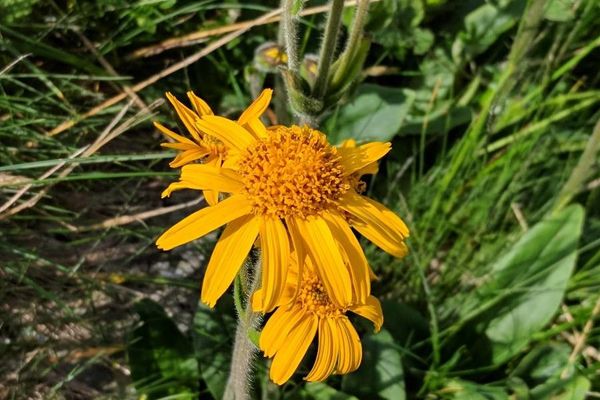
European arnica
Arnica montana
Родина: Asteraceae • Рід: Arnica
БагаторічнаСередньоДекоративна
вид рослин
Опис
Prefers a moist, well-drained humus rich soil, preferably lime-free. One report says that it is often found in calcareous soils in the wild. Tolerates a pH in the range 5.8 to 7.6. Prefers a mixture of sand, loam and peat. Prefers a position in full sun[1, 134]. Succeeds in light woodland and in a rock garden or border[1, 14]. Plants are hardy to about -25°c. This species is declining in the wild, probably because of over-collection as a medicinal herb. It may become extinct in part of its range. References Carbon Farming Information and Carbon Sequestration Information Temperature Converter Type a value in the Celsius field to convert the value to Fahrenheit: Celsius Fahrenheit: The PFAF Bookshop Plants For A Future have a number of books available in paperback and digital form. Book titles include Edible Plants , Edible Perennials , Edible Trees , Edible Shrubs , Woodland Gardening , and Temperate Food Forest Plants . Our new book is Food Forest Plants For Hotter Conditions (Tropical and Sub-Tropical) . Shop Now
Походження та ареал
EUROPE: Denmark, Norway, Sweden, Austria, Belgium, Switzerland, Czech Republic, Germany, Hungary (extinct?), Netherlands, Poland, Belarus, Lithuania (extinct?), Ukraine, Bulgaria, Bosnia and Herzegovina, Croatia, Italy, Montenegro, Romania, Slovenia, Spain, France, Portugal
Корисні властивості
None known References More on Edible Uses
Поради
Seed - best sown as soon as it is ripe in pots outdoors. Sow stored seed in early spring in a cold frame. A period of cold stratification is helpful. The fresh seed can germinate in 3 - 4 weeks at 13°c according to one report, though it can be slow, difficult and erratic and take 2 years to germinate. Prick out the seedlings into individual pots when they are large enough to handle and plant them out into their permanent positions in the following spring. Division in spring.