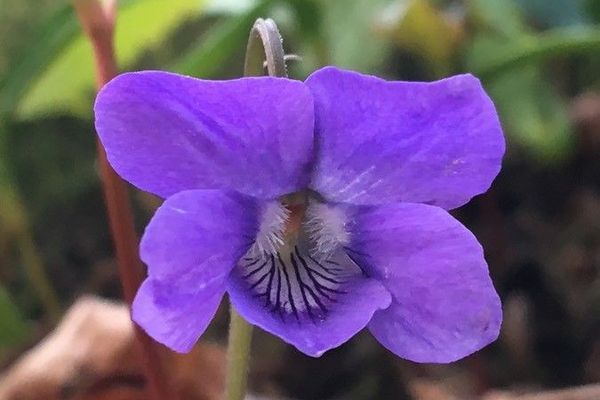
Wood violet
Viola riviniana
Родина: Violaceae • Рід: Viola
БагаторічнаСередньоДекоративна
Опис
Prefers a cool moist well-drained humus-rich soil in partial or dappled shade and protection from scorching winds. Tolerates sandstone and limestone soils but becomes chlorotic if the pH is too high. Prefers a pH between 6 and 6.5. A good butterfly plant. The plant flowers mainly during April to June but also produces cleistogomous flowers during the summer. These flowers do not open but fertilize themselves and produce viable seed. All members of this genus have more or less edible leaves and flower buds, though those species with yellow flowers can cause diarrhoea if eaten in large quantities[62, 85, 159]. References Carbon Farming Information and Carbon Sequestration Information Temperature Converter Type a value in the Celsius field to convert the value to Fahrenheit: Celsius Fahrenheit: The PFAF Bookshop Plants For A Future have a number of books available in paperback and digital form. Book titles include Edible Plants , Edible Perennials , Edible Trees , Edible Shrubs , Woodland Gardening , and Temperate Food Forest Plants . Our new book is Food Forest Plants For Hotter Conditions (Tropical and Sub-Tropical) . Shop Now
Походження та ареал
TEMPERATE ASIA: Lebanon EUROPE: Denmark, Finland, Faroe Islands, United Kingdom, Ireland, Iceland, Norway, Svalbard and Jan Mayen, Sweden, Czechoslovakia, Austria, Belgium, Switzerland, Germany, Hungary, Luxembourg, Netherlands, Poland, Russian Federation (European part), Belarus, Estonia, Lithuania, Latvia, Ukraine, Former Yugoslavia, Albania, Bulgaria, Greece, Italy (incl. Sardinia, Sicily), Romania, Andorra, Spain, France (incl. Corsica), Portugal AFRICA: Algeria, Morocco, Tunisia
Корисні властивості
Edible Parts: Flowers Leaves Edible Uses: Tea Young leaves and flower buds - raw or cooked. When added to soup they thicken it in much the same way as okra[85, 159]. Flowers and buds - raw. A tea can be made from the leaves. References More on Edible Uses
Поради
Seed - best sown in the autumn in a cold frame. Sow stored seed in early spring in a cold frame. Prick out the seedlings into individual pots when they are large enough to handle and plant them out in the summer. Division in the autumn or just after flowering. Larger divisions can be planted out direct into their permanent positions, though we have found that it is best to pot up smaller divisions and grow them on in light shade in a greenhouse or cold frame until they are growing away well. Plant them out in the summer or the following spring.