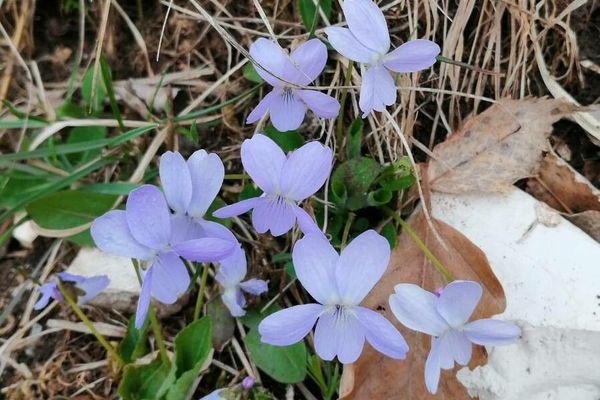
Hairy violet
Viola hirta
Родина: Violaceae • Рід: Viola
БагаторічнаСередньоДекоративна
Bloom Color: Pink, Purple, White. Main Bloom Time: Early fall, Early spring, Late fall, Late winter, Mid fall, Mid spring. Form: Spreading or horizontal.
Опис
Landscape Uses:Alpine garden, Border, Container, Ground cover, Massing, Rock garden, Woodland garden. Succeeds in most soils but prefers a cool moist well-drained humus-rich soil in partial or dappled shade and protection from scorching winds[1, 14, 31, 200]. When grown in the open it prefers a moderately heavy rich soil. Plants have done very well in a hot dry sunny position on our Cornish trial grounds[K]. Tolerates sandstone and limestone soils. Plants are hardy to about -20°c. Sweet violets are very ornamental plants, there are many named varieties. They produce their delicately scented flowers in late winter and early spring - these are designed for fertilisation by bees and since there are few bees around at this time of year these flowers seldom set seed. However, the plants also produce a second type of flower later in the year. These never open, but seed is produced within them by self-fertilization. The plants will often self-sow freely when well-sited. They can also spread fairly rapidly at the roots when they are growing well[K]. Responds well to an annual replanting in rich loose leafy soils. All members of this genus have more or less edible leaves and flower buds, though those species with yellow flowers can cause diarrhoea if eaten in large quantities[62, 85, 159]. Special Features: Edible, Not North American native, Invasive, Naturalizing, Suitable for cut flowers, Extended bloom season in Zones 9A and above, Fragrant flowers. For polyculture design as well as the above-ground architecture (form - tree, shrub etc. and size shown above) information on the habit and root pattern is also useful and given here if available. An evergreen. The plant growth habit is a runner spreading indefinitely by rhizomes or stolons [1-2]. The root pattern is rhizomatous with underground stems sending roots and shoots along their length [1-2]. The root pattern is stoloniferous rooting from creeping stems above the ground [1-2]. References Carbon Farming Information and Carbon Sequestration Information Temperature Converter Type a value in the Celsius field to convert the value to Fahrenheit: Celsius Fahrenheit: The PFAF Bookshop Plants For A Future have a number of books available in paperback and digital form. Book titles include Edible Plants , Edible Perennials , Edible Trees , Edible Shrubs , Woodland Gardening , and Temperate Food Forest Plants . Our new book is Food Forest Plants For Hotter Conditions (Tropical and Sub-Tropical) . Shop Now
Походження та ареал
TEMPERATE ASIA: Iran, Iraq (north), Lebanon, Turkey,Cyprus. TROPICAL ASIA: India, Jammu and Kashmir, EUROPE: Denmark, United Kingdom (U.K.), Ireland, Norway, Sweden, Czechoslovakia (Czech Republic and Slovakia), Austria, Belgium, Switzerland, Germany, Hungary, Netherlands, Poland, Russian Federation-European part, European part, Belarus, Moldova, Ukraine (incl. Krym), Former Yugoslavia, Albania, Bulgaria, Greece (incl. Crete), Italy (incl. Sardinia, Sicily), Romania, Spain (incl. Baleares), Fran
Корисні властивості
Young leaves and flower buds - raw or cooked[21, 85, 183]. Usually available all through the winter[K]. The leaves have a very mild flavour, though they soon become quite tough as they grow older. They make a very good salad, their mild flavour enabling them to be used in bulk whilst other stronger-tasting leaves can then be added to give more flavour[K]. When added to soup they thicken it in much the same way as okra[62, 85, 159]. Also used as a flavouring in puddings etc. A tea can be made from the leaves. Flowers - raw. Used to decorate salads and desserts[5, 9, 85]. A sweet mild flavour with a delicate perfume, the flowers are an especially welcome decoration for the salad bowl since they are available in late winter[K]. The flowers are also used fresh to flavour and colour confectionery. A soothing tea can be made from the leaves and flowers[85, 183]. A leaf extract is used to flavour sweets, baked goods and ice cream. References More on Edible Uses
Поради
Seed - best sown in the autumn in a cold frame. The seed requires a period of cold stratification and the germination of stored seed can be erratic. Prick out the seedlings into individual pots when they are large enough to handle and plant them out in the summer. Division in the autumn or just after flowering. Larger divisions can be planted out direct into their permanent positions, though we have found that it is best to pot up smaller divisions and grow them on in light shade in a greenhouse or cold frame until they are growing away well. Plant them out in the summer or the following spring.