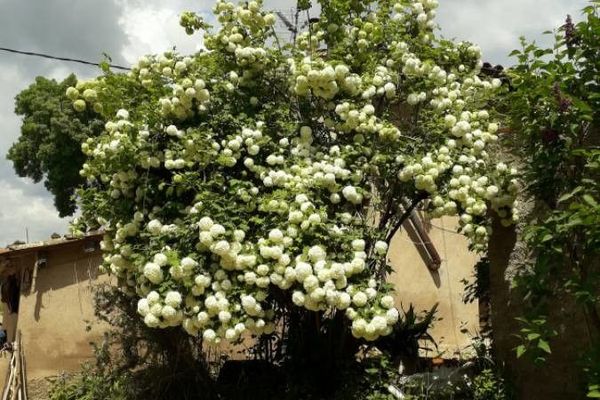
Crampbark
Viburnum opulus
Родина: Viburnaceae • Рід: Viburnum
БагаторічнаСередньоДекоративна
Bloom Color: White. Main Bloom Time: Early spring, Late spring, Mid spring. Form: Oval, Upright or erect .
Опис
Landscape Uses:Border, Massing, Screen, Specimen. An easily grown plant, it succeeds in most soils but is ill-adapted for poor soils and for dry situations. It prefers a deep rich moist loamy soil in a sunny position. Succeeds in semi-shade but does not grow or fruit so well in such a position. Grows well in heavy clay soils and on chalk. Does not do well on very acid soils. Best if given shade from the early morning sun in spring. A very ornamental plant, it is hardy to about -30°c and is often grown in the flower garden. There are many named varieties. Guelder rose regenerates quickly if it is cut to the ground, it can also produce suckers and will often form thickets. The plant is an alternative host for the broad bean aphid. Special Features: Not North American native, Naturalizing, Attractive flowers or blooms. In garden design, as well as the above-ground architecture of a plant, root structure considerations help in choosing plants that work together for their optimal soil requirements including nutrients and water. The root pattern is fleshy. Thick or swollen - fibrous or tap root [2-1]. References Carbon Farming Information and Carbon Sequestration Information Temperature Converter Type a value in the Celsius field to convert the value to Fahrenheit: Celsius Fahrenheit: The PFAF Bookshop Plants For A Future have a number of books available in paperback and digital form. Book titles include Edible Plants , Edible Perennials , Edible Trees , Edible Shrubs , Woodland Gardening , and Temperate Food Forest Plants . Our new book is Food Forest Plants For Hotter Conditions (Tropical and Sub-Tropical) . Shop Now
Походження та ареал
TEMPERATE ASIA: Russian Federation-Ciscaucasia (Ciscaucasia), Armenia, Azerbaijan, Georgia, Russian Federation (Dagestan), Russian Federation-Western Siberia (Western Siberia), Russian Federation-Eastern Siberia (Eastern Siberia (southeast)), Kazakhstan, Kyrgyzstan, Russian Federation (Kurile Islands, Primorye, Amur), China (Anhui Sheng, Heilongjiang Sheng, Henan Sheng, Hebei Sheng, Hubei Sheng, Gansu Sheng, Jiangxi Sheng, Jilin Sheng, Liaoning Sheng, Shanxi Sheng, Shandong Sheng, Shaanxi Sheng,
Корисні властивості
Edible Parts: Fruit Edible Uses: Fruit - raw or cooked[2, 3, 5, 46]. The fruit is up to 8.5mm in diameter but with a large seed. A sour taste, it is best cooked. The crushed fruit has an unpleasant smell. Used as a cranberry substitute in making, jellies, preserves etc. Some caution is advised, see notes on toxicity at top of the page. References More on Edible Uses
Поради
Seed - best sown in a cold frame as soon as it is ripe. Germination can be slow, sometimes taking more than 18 months. If the seed is harvested 'green' (when it has fully developed but before it has fully ripened) and sown immediately in a cold frame, it should germinate in the spring. Stored seed will require 2 months warm then 3 months cold stratification and can still take 18 months to germinate. Prick out the seedlings into individual pots when they are large enough to handle and grow them on in a cold frame or greenhouse. Plant out into their permanent positions in late spring or early summer of the following year. Cuttings of soft-wood, early summer in a frame. Pot up into individual pots once they start to root and plant them out in late spring or early summer of the following year. Cuttings of half-ripe wood, 5 - 8 cm long with a heel if possible, July/August in a frame[78, 113]. Plant them into individual pots as soon as they start to root. These cuttings can be difficult to overwinter, it is best to keep them in a greenhouse or cold frame until the following spring before planting them out. Cuttings of mature wood, winter in a frame. They should root in early spring - pot them up when large enough to handle and plant them out in the summer if sufficient new growth is made, otherwise keep them in a cold frame for the next winter and then plant them out in the spring. Layering of current seasons growth in July/August. Takes 15 months.