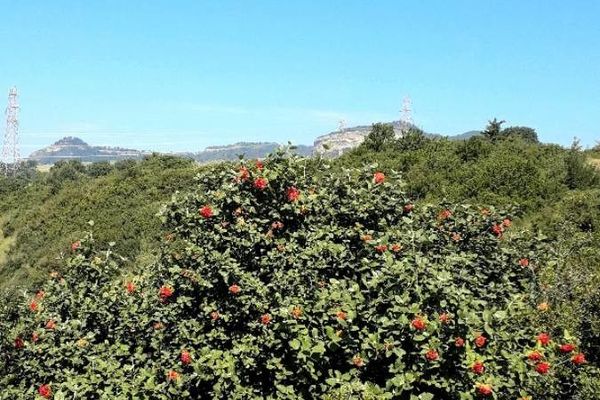
Mealytree
Viburnum lantana
Родина: Viburnaceae • Рід: Viburnum
БагаторічнаСередньоДекоративна
Bloom Color: White. Main Bloom Time: Early spring, Late spring, Mid spring. Form: Rounded.
Опис
Landscape Uses:Border, Massing, Screen, Specimen. An easily grown plant, it succeeds in most soils but is ill-adapted for poor soils and for dry situations. Unlike most members of the genus, this species succeeds on dry soils. It prefers a deep rich moist loamy soil in sun or semi-shade[11, 200], growing well on chalk and on chalky clays. Intolerant of water-logged soils. Best if given shade from the early morning sun in spring. Dislikes atmospheric pollution. Plants regenerate well after cutting. This plant is a good indicator of limy soils. Tolerates light shade in a woodland. One report says the plant is self-sterile, another that it is self-fertile. It would be wise to grow at least two genetically distinct plants of the same species in order to make sure that fruit and seed is produced. Special Features: Not North American native, Naturalizing, Fragrant flowers, Blooms are very showy. References Carbon Farming Information and Carbon Sequestration Information Temperature Converter Type a value in the Celsius field to convert the value to Fahrenheit: Celsius Fahrenheit: The PFAF Bookshop Plants For A Future have a number of books available in paperback and digital form. Book titles include Edible Plants , Edible Perennials , Edible Trees , Edible Shrubs , Woodland Gardening , and Temperate Food Forest Plants . Our new book is Food Forest Plants For Hotter Conditions (Tropical and Sub-Tropical) . Shop Now
Походження та ареал
TEMPERATE ASIA: Iran (north), Turkey, Russian Federation-Ciscaucasia (Ciscaucasia), Armenia, Azerbaijan, Georgia, Russian Federation (Dagestan) EUROPE: United Kingdom, Czechoslovakia, Austria, Belgium, Switzerland, Germany, Hungary, Russian Federation (European part), Belarus, Ukraine (incl. Krym), Former Yugoslavia, Albania, Bulgaria, Greece (incl. Crete), Italy, Romania, Spain, France AFRICA: Algeria, Morocco
Корисні властивості
Edible Parts: Fruit Edible Uses: Fruit - raw or cooked. A famine food, it is only used when all else fails. The oblong fruit is about 8mm long and contains a single large seed. References More on Edible Uses
Поради
Seed - best sown in a cold frame as soon as it is ripe. Germination can be slow, sometimes taking more than 18 months. If the seed is harvested 'green' (when it has fully developed but before it has fully ripened) and sown immediately in a cold frame, it should germinate in the spring. Stored seed will require 2 months warm then 3 months cold stratification and can still take 18 months to germinate. Prick out the seedlings into individual pots when they are large enough to handle and grow them on in a cold frame or greenhouse. Plant out into their permanent positions in late spring or early summer of the following year. Cuttings of soft-wood, early summer in a frame. Pot up into individual pots once they start to root and plant them out in late spring or early summer of the following year. Cuttings of half-ripe wood, 5 - 8 cm long with a heel if possible, July/August in a frame[78, 113]. Plant them into individual pots as soon as they start to root. These cuttings can be difficult to overwinter, it is best to keep them in a greenhouse or cold frame until the following spring before planting them out. Cuttings of mature wood, winter in a frame. They should root in early spring - pot them up when large enough to handle and plant them out in the summer if sufficient new growth is made, otherwise keep them in a cold frame for the next winter and then plant them out in the spring. Layering of current seasons growth in July/August. Takes 15 months.