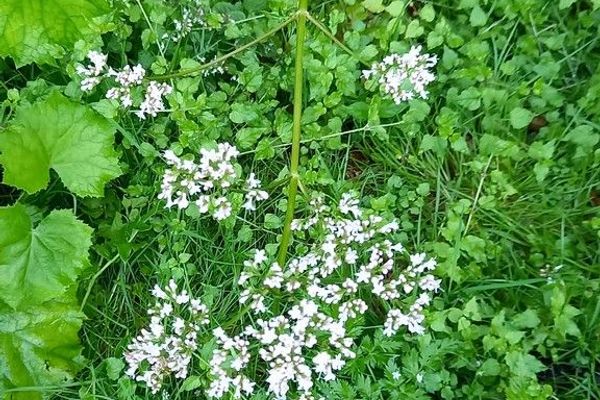
Опис
A very easily grown plant, it succeeds in ordinary garden soil, preferring a rich heavy loam in a moist site[4, 7, 17]. Thrives in full sun or in partial shade, doing well in light woodland. A polymorphic species, the more extreme variations are given specific status by some botanists. Valerian is often grown in the herb garden and also sometimes grown commercially as a medicinal herb[1, 200]. When grown for its medicinal root, the plant should not be allowed to flower. The flowers and the dried roots have a strong smell somewhat resembling stale perspiration. Cats are very fond of this plant, particularly the powdered root[1, 4, 20]. Once a cat has discovered a plant they will often destroy it by constantly rolling over it.The dried root also attracts rats and can be used as a bait in traps[4, 14]. A good companion for most plants. In garden design, as well as the above-ground architecture of a plant, root structure considerations help in choosing plants that work together for their optimal soil requirements including nutrients and water. The root pattern is fleshy. Thick or swollen - fibrous or tap root [2-1]. Valeriana officinalis, also known as common valerian, is self-pollinating and can self-seed. It can also spread by rhizomes and runners. The roots are typically harvested in autumn after the leaves have died down, while the flowers can be harvested in late spring to early summer. Valerian flowers in late spring to early summer. Valerian has a moderate growth rate, typically taking a couple of years to establish fully before significant harvests can occur. References Carbon Farming Information and Carbon Sequestration Information Temperature Converter Type a value in the Celsius field to convert the value to Fahrenheit: Celsius Fahrenheit: The PFAF Bookshop Plants For A Future have a number of books available in paperback and digital form. Book titles include Edible Plants , Edible Perennials , Edible Trees , Edible Shrubs , Woodland Gardening , and Temperate Food Forest Plants . Our new book is Food Forest Plants For Hotter Conditions (Tropical and Sub-Tropical) . Shop Now
Походження та ареал
TEMPERATE ASIA: Iran, Turkey, Russian Federation-Ciscaucasia (Ciscaucasia), Armenia, Azerbaijan, Georgia, Russian Federation (Dagestan), Russian Federation-Western Siberia (Western Siberia), Russian Federation-Eastern Siberia (Eastern Siberia), Russian Federation (Kurile Islands (south), Primorye, Sakhalin), China (north), Korea, Japan (Hokkaidô, Honshu, Kyushu, Shikoku), Taiwan EUROPE: Denmark, Finland, United Kingdom, Ireland, Iceland, Norway, Sweden, Czechoslovakia, Austria, Belgium, Switzerl
Корисні властивості
Edible Parts: Seed Edible Uses: Condiment Tea Seed. No further details are given but the seeds of other members of this genus are parched and then eaten. An essential oil from the leaves and root is used as a flavouring in ice cream, baked goods, condiments etc. It is especially important in apple flavours. The leaves can also be used as a condiment. The plant is used in moderation as a herbal tea. References More on Edible Uses
Поради
Seed - sow spring in a cold frame and only just cover the seed because it requires light for germination. Prick out the seedlings into individual pots when they are large enough to handle and plant out into their permanent positions in the summer if sufficient growth has been made. If the plants are too small to plant out, grow them on in the greenhouse or frame for their first winter and plant them out early in the following summer. Division in spring. Larger divisions can be planted out direct into their permanent positions. We have found that it is best to pot up smaller divisions and grow them on in light shade in a greenhouse or cold frame until they are growing away well. Plant them out in the summer or the following spring.