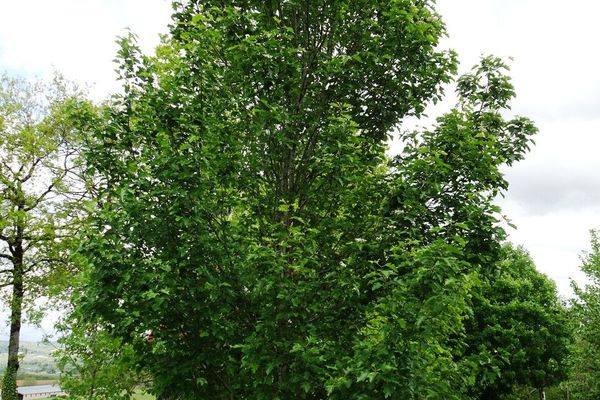
Опис
Succeeds in reasonably good soils so long as they are not too poor or acid, in an open sunny position[1, 11]. Prefers clay soils[3, 11]. Tolerates moderate shade but does not fruit so well in such a position[K]. Grows best in the eastern half of Britain. Plants are susceptible to fireblight. Plants respond well to coppicing. When found in a truly wild situation, this species indicates primary woodland. In garden design, as well as the above-ground architecture of a plant, root structure considerations help choose plants that work together for their optimal soil requirements, including nutrients and water. The root pattern is branching: a heart root, dividing from the crown into several primary roots going down and out [2-1]. Sorbus species, known as rowan or service trees, provide both edible fruit and ornamental value, making them good choices for food forests. Several Sorbus species, such as S. domestica, S. torminalis, and S. aria, are more adaptable to the warm, dry summers and mild, wet winters of Mediterranean climates. S. aucuparia may also be grown in cooler or higher elevation areas within Mediterranean climates, though it prefers less heat. The fruits are typically harvested in late summer to early autumn, from August to October (Northern Hemisphere), once fully ripe. Sorbus species usually flower in late spring to early summer, generally from May to June (Northern Hemisphere), producing clusters of white or pink flowers. Sorbus species are generally moderate to fast-growing, with some reaching maturity in about 5 to 10 years, depending on species and growing conditions. The Wild service tree (Sorbus torminalis) can be self-fertile but also partially self-incompatible. References Carbon Farming Information and Carbon Sequestration Information Temperature Converter Type a value in the Celsius field to convert the value to Fahrenheit: Celsius Fahrenheit: The PFAF Bookshop Plants For A Future have a number of books available in paperback and digital form. Book titles include Edible Plants , Edible Perennials , Edible Trees , Edible Shrubs , Woodland Gardening , and Temperate Food Forest Plants . Our new book is Food Forest Plants For Hotter Conditions (Tropical and Sub-Tropical) . Shop Now
Походження та ареал
TEMPERATE ASIA: Cyprus, Iran (northwest), Lebanon, Syria, Turkey, Russian Federation-Ciscaucasia (Ciscaucasia), Armenia, Azerbaijan, Georgia EUROPE: Denmark, United Kingdom, Austria, Belgium, Switzerland, Czech Republic, Germany, Hungary, Poland, Slovakia, Moldova, Ukraine (incl. Krym), Albania, Bulgaria, Bosnia and Herzegovina, Greece, Croatia, Italy (incl. Sardinia, Sicily), North Macedonia, Montenegro, Romania, Serbia, Slovenia, Spain, France, Portugal AFRICA: Algeria, Morocco, Tunisia
Корисні властивості
Fruit - raw or cooked[2, 5, 11, 74, 115, 183]. The taste is best after a frost because it turns sweeter. The fruit can also be bletted if it is going to be eaten raw[3, 183]. This involves storing the fruit in a cool dry place until it is almost but not quite going rotten. At this stage the fruit has a delicious taste, somewhat like a luscious tropical fruit. Rich in vitamin C. The fruit is up to 1.5cm across and is borne in bunches which makes it easier to harvest[K]. References More on Edible Uses
Поради
Seed - best sown as soon as it is ripe in a cold frame[78, 80]. If you have sufficient seed it can be sown in an outdoor seedbed[78, 80]. Stored seed germinates better if given 2 weeks warm then 14 - 16 weeks cold stratification, so sow it as early in the year as possible. Prick out the seedlings into individual pots when they are large enough to handle. Seedlings are very slow to put on top-growth for their first year or two, but they are busy building up a good root system. It is best to keep them in pots in a cold frame for their first winter and then plant them out into their permanent positions in late spring.