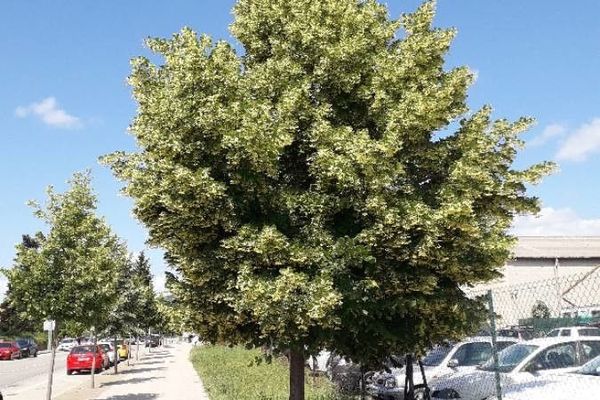
Linden
Tilia platyphyllos
Родина: Malvaceae • Рід: Tilia
БагаторічнаСередньоДекоративна
Taxonomic Note: This genus was formerly classified in the family Tiliaceae. Modern classifications include it within the Malvaceae. Bloom Color: Yellow. Main Bloom Time: Early summer, Late summer, Mid summer. Form: Oval, Pyramidal.
Опис
Landscape Uses:Espalier, Pollard, Screen, Specimen. Prefers a good moist loamy alkaline to neutral soil but succeeds on slightly acid soils[11, 200]. Grows poorly on any very dry or very wet soils. Succeeds in sun or semi-shade. Plants can be transplanted quite easily, even when quite large, trees up to 60 years old have been moved successfully[1, 74]. Lime trees are very long-lived and are amenable to coppicing or pollarding. This species does not produce many suckers[98, 200]. Grows well in Britain, it is the only species that reliably produces viable seed in areas with cool summers. Lime trees tend to hybridise freely if other members of the genus are growing nearby. If growing plants from seed it is important to ensure the seed came from a wild source or from an isolated clump of the single species[K]. Grows best in a woodland situation, young plants tolerate a reasonable level of side shade. Mature trees cast a dense shade. A very valuable bee plant, producing an abundance of nectar[7, 11, 125]. A valuable tree for wildlife, there are 31 species of insects associated with this tree. A food plant for the caterpillars of many butterfly and moth species. Trees are usually attacked by aphids which cover the ground and the leaves with a sticky honeydew. There are some named varieties selected for their ornamental value. Plants in this genus are notably resistant to honey fungus. Special Features:Not North American native, Fragrant flowers, Attractive flowers or blooms. References Carbon Farming Information and Carbon Sequestration Information Temperature Converter Type a value in the Celsius field to convert the value to Fahrenheit: Celsius Fahrenheit: The PFAF Bookshop Plants For A Future have a number of books available in paperback and digital form. Book titles include Edible Plants , Edible Perennials , Edible Trees , Edible Shrubs , Woodland Gardening , and Temperate Food Forest Plants . Our new book is Food Forest Plants For Hotter Conditions (Tropical and Sub-Tropical) . Shop Now
Походження та ареал
TEMPERATE ASIA: Turkey (west) EUROPE: Denmark, Czechoslovakia, Austria, Belgium, Switzerland, Hungary, Netherlands, Poland, Moldova, Ukraine, Former Yugoslavia, Albania, Bulgaria, Greece, Italy, Romania, Spain, France (incl. Corsica)
Корисні властивості
Edible Parts: Leaves Sap Edible Uses: Chocolate Tea Young leaves - raw. A delicious addition to salads and sandwiches, the young leaves are mild and tender with a somewhat mucilaginous texture[K]. A very acceptable chocolate substitute can be made from a paste of the ground-up flowers and immature fruit. Trials on marketing the product failed because the paste is very apt to decompose[2, 115]. A popular herb tea is made from the flowers, it has a sweet, fragrant pleasant flavour. Some caution is advised, see notes above on toxicity. Sap - harvested in the spring, it is sweet and can be used as a drink or concentrated into a syrup. References More on Edible Uses
Поради
Seed - much of the seed produced in Britain is not viable, cut a few seedcases open to see if there is a seed inside. If possible, obtain fresh seed that is ripe but has not as yet developed a hard seed coat and sow it immediately in a cold frame. It may germinate in the following spring though it could take 18 months. Stored seed can be very slow to germinate. It has a hard seed coat, embryo dormancy and a hard coat on the pericarp. All these factors mean that the seed may take up to 8 years to germinate. One way of shortening this time is to stratify the seed for 5 months at high temperatures (10°c at night, up to 30°c by day) and then 5 months cold stratification. When they are large enough to handle, prick the seedlings out into individual pots and grow them on in the greenhouse for their first winter. Plant them out into their permanent positions in late spring or early summer, after the last expected frosts. Layering in spring just before the leaves unfurl. Takes 1 - 3 years. Suckers, when formed, can be removed with as much root as possible during the dormant season and replanted immediately.