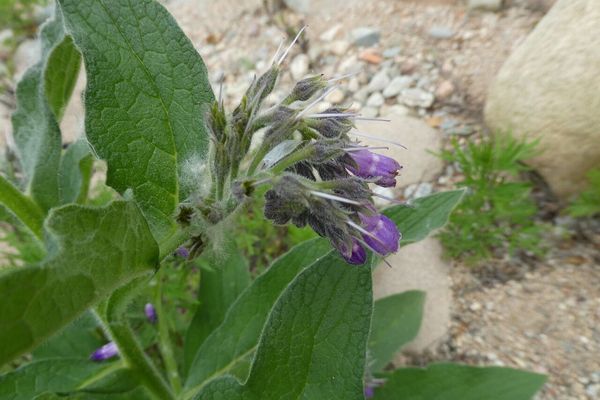
Опис
Tolerates most soils and situations but prefers a moist soil and some shade[1, 4]. Grows well in heavy clay soils. Best grown in an open sunny site in a deep rich soil if it is being grown for compost material. Plants can be invasive, often spreading freely by means of self-sown seed. The root system is very deep and difficult to eradicate, even small fragments of root left in the soil can produce new plants. Special Features:Attractive foliage, Edible, Fragrant foliage, Not North American native, Invasive, Naturalizing. The plant is heat tolerant in zones 9 through 1. (Plant Hardiness Zones show how well plants withstand cold winter temperatures. Plant Heat Zones show when plants would start suffering from the heat. The Plant Heat Zone map is based on the number of "heat days" experienced in a given area where the temperature climbs to over 86 degrees F (30°C). At this temperature, many plants begin to suffer physiological damage. Heat Zones range from 1 (no heat days) to 12 (210 or more heat days). For example Heat Zone. 11-1 indicates that the plant is heat tolerant in zones 11 through 1.) For polyculture design as well as the above-ground architecture (form - tree, shrub etc. and size shown above) information on the habit and root pattern is also useful and given here if available. The plant growth habit is a clumper with limited spread [1-2]. The root pattern is fibrous dividing into many fine roots [1-2]. The root pattern is fleshy. Thick or swollen - fibrous or tap root [1-2]. The leaves can be harvested in late spring to early summer (May to June, Northern Hemisphere) when they are young and tender. Comfrey flowers from late spring to early summer (May to June, Northern Hemisphere). Comfrey is a fast-growing perennial herb, capable of reaching full size within a few months of planting. It can produce multiple harvests per growing season. Symphytum officinale (Common Comfrey) is self-fertile, meaning it can produce seeds from its pollen without cross-pollination. However, it is also pollinated by bees and other insects, which can enhance seed production. Many comfrey cultivars, especially Bocking 14, are sterile and do not set seed, but the wild-type species can self-fertilise. References Carbon Farming Information and Carbon Sequestration Information Temperature Converter Type a value in the Celsius field to convert the value to Fahrenheit: Celsius Fahrenheit: The PFAF Bookshop Plants For A Future have a number of books available in paperback and digital form. Book titles include Edible Plants , Edible Perennials , Edible Trees , Edible Shrubs , Woodland Gardening , and Temperate Food Forest Plants . Our new book is Food Forest Plants For Hotter Conditions (Tropical and Sub-Tropical) . Shop Now
Походження та ареал
TEMPERATE ASIA: Ciscaucasia, Kazakhstan, Russian Federation-Ciscaucasia, Russian Federation-Western Siberia, Western Siberia (west),Turkey. EUROPE: United Kingdom (U.K.), Austria, Belgium, Switzerland, Czech Republic, Germany, Hungary, Netherlands, Poland, Slovakia, Russian Federation-European part, European part, Belarus, Moldova, Ukraine (incl. Krym), Bulgaria, Croatia, Italy (incl. Sardinia, Sicily), Romania, Serbia, Slovenia, Spain, France,
Корисні властивості
Edible Parts: Leaves Shoots Edible Uses: Gum Tea Young leaves - cooked or raw[2, 4, 5, 9, 46, 61]. The leaf is hairy and the texture is mucilaginous. It may be full of minerals but it is not pleasant eating for most tastes. It can be chopped up finely and added to salads, in this way the hairiness is not so obvious[183, K]. Young shoots can be used as an asparagus substitute. The blanched stalks are used. Older leaves can be dried and used as a tea. The peeled roots are cut up and added to soups. A tea is made from the dried leaves and roots. The roasted roots are used with dandelion and chicory roots for making coffee. References More on Edible Uses
Поради
Seed - sow spring or autumn in a cold frame. When they are large enough to handle, prick the seedlings out into individual pots and grow them on in the greenhouse for their first winter. Plant them out into their permanent positions in late spring or early summer, after the last expected frosts. If you have sufficient seed you can try an outdoor sowing in situ in the spring. Division succeeds at almost any time of the year. Simply use a spade to chop off the top 7cm of root just below the soil level. The original root will regrow and you will have a number of root tops, each of which will make a new plant. These can either be potted up or planted out straight into their permanent positions.