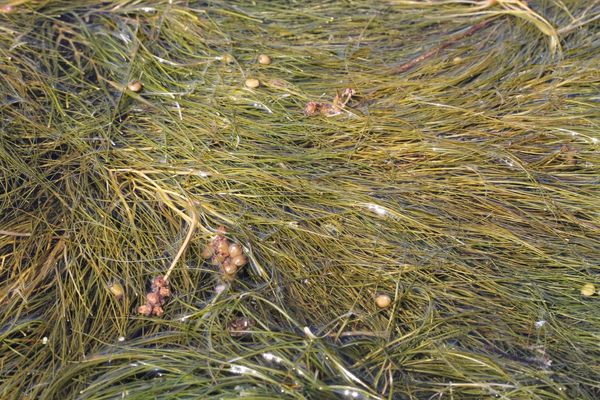
Опис
Stuckenia pectinata is a cosmopolitan plant found in most regions, though not in Australia. The plant can grow in nearly all bottom substrates and tolerate high salinity, pH, and alkaline water[277 ]. It is best given a loam based medium in full sun[200 ]. Plants can tolerate up to 3 months in a year when the water is absent[277 ]. A polymorphic species[17 ]. A fast-growing plant needs constant checking to ensure it does not overrun the pond[200 ]. It provides a good food source for ducks and other water fowl[212 ]. Plants do not flower every year[212 ]. Hybridizes freely with other members of this genus; the resulting progeny is usually sterile[200 ]. USDA Hardiness Zone: 4–10. Weed Potential: Moderate. In some regions outside the Southwest, sago pondweed can become invasive in ponds and waterways, where it spreads rapidly and forms dense mats. References Carbon Farming Information and Carbon Sequestration Information Temperature Converter Type a value in the Celsius field to convert the value to Fahrenheit: Celsius Fahrenheit: The PFAF Bookshop Plants For A Future have a number of books available in paperback and digital form. Book titles include Edible Plants , Edible Perennials , Edible Trees , Edible Shrubs , Woodland Gardening , and Temperate Food Forest Plants . Our new book is Food Forest Plants For Hotter Conditions (Tropical and Sub-Tropical) . Shop Now
Походження та ареал
Native to: Afghanistan, Alabama, Alaska, Albania, Alberta, Aleutian Is., Algeria, Altay, Amur, Angola, Arizona, Arkansas, Assam, Austria, Baleares, Baltic States, Bangladesh, Belarus, Belgium, Belize, Bolivia, Botswana, British Columbia, Bulgaria, Burundi, Buryatiya, California, Cape Provinces, Caprivi Strip, Central American Pac, Central European Rus, Chile Central, China North-Central, China South-Central, China Southeast, Chita, Colombia, Colorado, Connecticut, Corse, Cuba, Cyprus, Czechoslov
Корисні властивості
Leaves and stems[105 ]. No more details are given. Root - raw[105 ]. It tastes like nuts[85 ]. The outer rind should be removed[85 ]. The roots of sago pondweed are edible, though this species, along with other pondweeds, is rarely abundant in the arid Southwest due to a lack of suitable aquatic habitats. Where it occurs in lakes, ponds, and slow-moving waterways, the starchy roots can be harvested and eaten after proper cleaning and cooking [2-3]. Nutritional & Foraging Notes: While pondweeds have a history of being consumed in some regions, in the Southwest US, they were generally too scarce to be reliable food sources. Roots are typically starchy, providing a modest source of carbohydrates. Harvesting would require wading into aquatic habitats and carefully uprooting the plants [2-3]. References More on Edible Uses