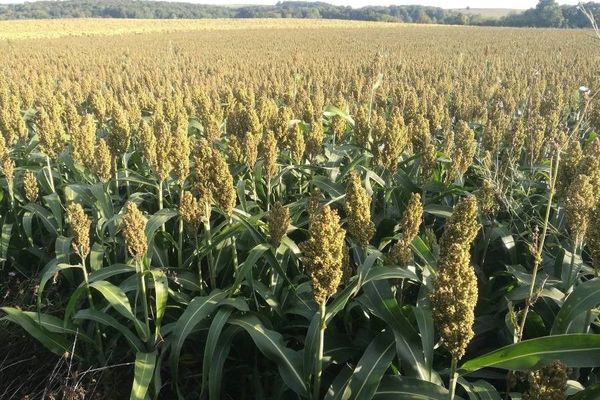
Great millet
Sorghum bicolor
Родина: Poaceae • Рід: Sorghum
БагаторічнаСередньоДекоративна
Drill seed 1/2 in deep in rows 24–30 in apart, thinning to 6–8 in within the row once plants are established; grain sorghum stalls visibly during drought but resumes growth when moisture returns, unlike corn which suffers permanent yield loss. The compact seed heads (panicles) are ready to harvest w
Опис
A fairly easily grown plant, though it is on the edges of its climatic zone in Britain. It requires a warm, sheltered and sunny position, preferring a slightly to moderately acid soil[160, 269], though some cultivars have succeeded with a pH as high as 8. Plants are adapted to a wide range of soils varying from light loams to heavy clays, they thrive best on light, easily worked soils of high fertility, with moderate to high availablility of water. Moderately well-drained soils are suitable for sorghums. Small amounts of alkali in sand reduces performance considerably. Plants are moderatley tolerant of saline soils. Established plants are very drought resistant, they succeed in arid soils. A nitrogen rich soil causes the plants to lodge. Plants are reported to tolerate an annual precipitation in the range of 20 to 410cm, an annual temperature in the range of 7.8 to 27.8°C and a pH of 4.3 to 8.7. Sorghum is widely cultivated in tropical and warm temperate zones for its edible seed, as well as for its panicles (which are used as brooms) and the syrup obtained from its sap. Yields of around 6 tonnes per hectare have been achieved, though yields as low as 200 kilos have been reported - yields below 2 tonnes are not considered financially viable.There are many named varieties[4, 50, 61, 183]. Some cultivars are short-day plants and are unlikely to produce flowers and seed away from the tropical zone. Plants are adapted to tropical and subtropical summer rainfall climates with rainfall from 25 - 125 cm annually, they are of little importance in more humid areas with higher rainfall. It is grown in Britain as a tender bedding plant but requires a long hot summer if it is to ripen its seed here. In warmer climates it takes 3 months from sowing to seed harvest. References Carbon Farming Information and Carbon Sequestration Information Temperature Converter Type a value in the Celsius field to convert the value to Fahrenheit: Celsius Fahrenheit: The PFAF Bookshop Plants For A Future have a number of books available in paperback and digital form. Book titles include Edible Plants , Edible Perennials , Edible Trees , Edible Shrubs , Woodland Gardening , and Temperate Food Forest Plants . Our new book is Food Forest Plants For Hotter Conditions (Tropical and Sub-Tropical) . Shop Now
Походження та ареал
AFRICA: Egypt, Ethiopia, Sudan, Somalia, Chad, Kenya, Tanzania, Uganda, Central African Republic, Cameroon, Democratic Republic of the Congo, Gabon, Equatorial Guinea, Benin, Burkina Faso, Côte D‘Ivoire, Ghana, Guinea, Gambia, Liberia, Mali, Mauritania, Niger, Nigeria, Senegal, Sierra Leone, Angola, Mozambique, Malawi, Zambia, Zimbabwe, Botswana, Namibia, Eswatini, South Africa
Корисні властивості
Edible Parts: Seed Stem Edible Uses: Colouring Sweetener Seed - raw or cooked. It is used as a whole grain in similar ways to rice, it can be popped much like popcorn, or can be ground into a flour and made into bread etc[2 , 4 , 57 , 162 , 183 ]. The ground seed yields a particularly white flour[7 ]. Sorghum is a staple food in some regions, where it is often fermented (lactic acid fermentation) before being eaten[183 ]. The sprouted seed can be eaten raw, and is sometimes added to salads[183 ]. The seed is germinated, then dried and ground into a powder to form malt, which is used as a substratum for fermentation in local beer production[299 ]. Stems - cooked[105 ]. Some caution is advised here, there are some reports that the leaves can contain the poison cyanide[4 ]. The stems of sweet sorghum types are chewed like sugar cane and, mainly in the United States, a sweet syrup is pressed from them[299 ]. Sap - raw or cooked. Very sweet, it is made into a syrup[1 , 2 , 46 , 57 , 257 ]. References More on Edible Uses Composition Figures in grams (g) or miligrams (mg) per 100g of food. Seed (Dry weight) 342 Calories per 100g Water : 12% Protein: 10g; Fat: 3.7g; Carbohydrate: 72.7g; Fibre: 2.2g; Ash: 1.5g; Minerals - Calcium: 22mg; Phosphorus: 242mg; Iron: 3.8mg; Magnesium: 0mg; Sodium: 8mg; Potassium: 44mg; Zinc: 0mg; Vitamins - A: 0mg; Thiamine (B1): 0.33mg; Riboflavin (B2): 0.18mg; Niacin: 3.9mg; B6: 0mg; C: 0mg; Reference: [ 269] Notes:
Поради
Seed - sow April in a greenhouse and only just cover the seed. Germination should take place within 2 weeks if given a minimum germination temperature of 23°c. Prick out the seedlings into individual pots once they are large enough to handle and plant them out after the last expected frosts. Consider giving them some protection, such as a cloche, until they are growing away strongly.