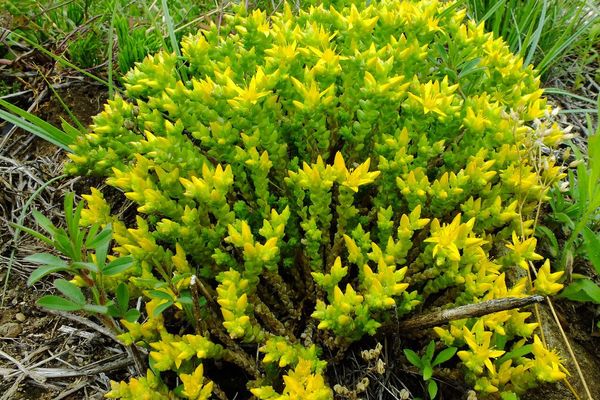
Biting stonecrop
Sedum acre
Родина: Crassulaceae • Рід: Sedum
БагаторічнаСередньоДекоративна
Bloom Color: Yellow. Main Bloom Time: Early summer, Late summer, Mid summer. Form: Spreading or horizontal.
Опис
Landscape Uses:Container, Ground cover, Rock garden, Seashore, Specimen. A very easily grown plant, it succeeds in most soils but prefers a sunny position in a fertile well-drained soil. Established plants are drought tolerant. Grows well on walls. Plants can be very aggressive and invasive, spreading freely at the roots. If clearing the plant from an area it is quite important to try and remove every part of the plant since even a small part of the stem, if left in the ground, can form roots and develop into a new plant. All members of this genus are said to have edible leaves, though those species, such as this one, that have yellow flowers can cause stomach upsets if they are eaten in quantity[62, 85]. Plants in this genus seem to be immune to the predations of rabbits. Special Features: Attractive foliage, Not North American native, Invasive, Naturalizing. References Carbon Farming Information and Carbon Sequestration Information Temperature Converter Type a value in the Celsius field to convert the value to Fahrenheit: Celsius Fahrenheit: The PFAF Bookshop Plants For A Future have a number of books available in paperback and digital form. Book titles include Edible Plants , Edible Perennials , Edible Trees , Edible Shrubs , Woodland Gardening , and Temperate Food Forest Plants . Our new book is Food Forest Plants For Hotter Conditions (Tropical and Sub-Tropical) . Shop Now
Походження та ареал
TEMPERATE ASIA: Turkey, Russian Federation-Ciscaucasia (Ciscaucasia), Russian Federation-Western Siberia (Western Siberia) EUROPE: Sweden, Austria, Switzerland, Czech Republic, Germany, Hungary, Netherlands, Poland, Slovakia, Russian Federation (European part), Ukraine (incl. Krym), Albania, Bulgaria, Bosnia and Herzegovina, Greece, Croatia, Italy, Montenegro, Romania, Serbia, Slovenia, Spain, France, Portugal AFRICA: Algeria, Libya, Morocco, Tunisia
Корисні властивості
Edible Parts: Leaves Edible Uses: Condiment Leaves - raw or cooked[13, 100]. Rich in vitamin C, but it has a bitter acrid taste[1, 244]. The main interest in the edible qualities of this plant is as a survival food, since it grows wild in the driest deserts as well as in arctic conditions. Large quantities can cause stomach upsets. It is best to dry the leaves (which can be difficult because they are very fleshy) and then powder them and use them to add a peppery taste to foods. The leaves are dried and ground into a powder to make a spicy seasoning. References More on Edible Uses
Поради
Seed - surface sow in spring in well-drained soil in a sunny position in a greenhouse. Do not allow the soil to dry out. It can also be sown in the autumn in a cold frame, some seed germinates immediately whilst others germinate in the spring. Prick out the seedlings into individual pots when they are large enough to handle. If sufficient growth is made, it is possible to plant them out during the summer, otherwise keep them in a cold-frame or greenhouse for their first winter and plant them out in early summer of the following year[K]. Division is very easy and can be carried out at almost any time in the growing season, though is probably best done in spring or early summer. Larger divisions can be planted out direct into their permanent positions. We have found it best to pot up the smaller divisions and grow them on in a lightly shaded position in a cold frame, planting them out once they are well established in the summer.