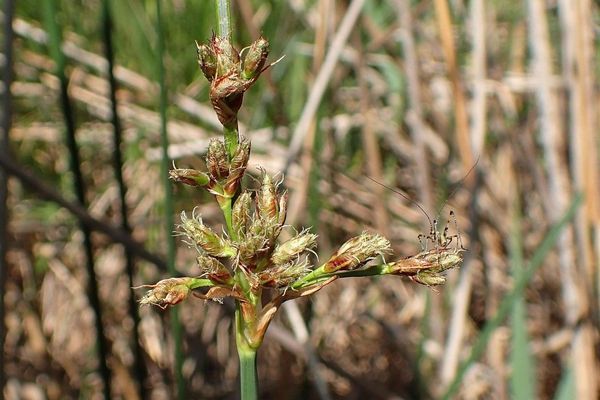
Опис
Identification & Habit: This is the “soft-to-the-squeeze” round-stem bulrush: culms are circular in cross-section, smooth, bluish-green, and easily indented by thumb pressure. The inflorescence is a lateral-appearing cluster near the apex, subtended by a bract that continues the culm line. Rhizomes are thick, fibrous, and branching; cut surfaces show dull-white tissue, sometimes with pink or yellow tints. Height usually 1–2.5 m, spreading 1–3 m or more in favorable, shallow water. Growing Conditions: Performs in shallow water (5–30 cm) or saturated soils, full sun preferred. Adaptable to a range of mineral and organic sediments with pH 6–8. Tolerates moderate nutrient loads and is widely used in constructed wetlands for polishing effluent. Habitat & Range: Widespread across North America, Europe, Asia, Africa, and Australasia in lakeshores, marshes, and low-energy river margins. In the Southwest it is frequent in reservoirs, stock ponds, and natural marshes. Size & Landscape Performance: Forms tall, elegant drifts that read as vertical ribbons in designed wetlands. It traps sediment, reduces wave energy, and offers year-round cover. Dead culms persist into winter, maintaining structure for wildlife. Cultivation (Horticulture): Plant rhizome divisions into pond shelves or saturated basins. Maintain stable hydrology during establishment. Once rooted, clumps expand steadily; thinning may be needed to preserve open water. Pests & Problems: Few insect issues; lodging in high winds can occur late season. Excessive drawdown may expose rhizomes to frost heaving at high latitudes. Tall, soft, spongy stems; small, brownish spikelets. It is anemophilous (wind-pollinated), matching the rest of the bulrush group, with rare incidental insect involvement. References Carbon Farming Information and Carbon Sequestration Information Temperature Converter Type a value in the Celsius field to convert the value to Fahrenheit: Celsius Fahrenheit: The PFAF Bookshop Plants For A Future have a number of books available in paperback and digital form. Book titles include Edible Plants , Edible Perennials , Edible Trees , Edible Shrubs , Woodland Gardening , and Temperate Food Forest Plants . Our new book is Food Forest Plants For Hotter Conditions (Tropical and Sub-Tropical) . Shop Now
Походження та ареал
US. USA. Afghanistan, Alabama, Alaska, Albania, Alberta, Algeria, Altay, Amur, Argentina Northeast, Argentina Northwest, Arizona, Arkansas, Austria, Bahamas, Baleares, Baltic States, Bangladesh, Belarus, Belgium, Bermuda, Brazil South, British Columbia, Bulgaria, Buryatiya, California, Cayman Is., Central European Russia, China North-Central, China South-Central, China Southeast, Chita, Colorado, Connecticut, Corse, Costa Rica, Cuba, Czechia-Slovakia, Delaware, Denmark, District of Columbia, Eas
Корисні властивості
Edible Uses & Rating: Rhizomes and achenes are the main foods; stem bases contribute chewable fiber with small starch reserves; pollen can be collected as a yellow meal in season. The rhizome liquor is unusually sweet and clean [2-3]. Edibility rating: 4/5, especially as a broth/flour resource. Taste, Processing & Kitchen Notes: Boiling chopped rhizomes releases soluble carbohydrates into a translucent, gently sweet liquor reminiscent of barley water. Reducing the concentration of sweetness for a pleasant beverage or soup base. Rhizome flesh itself can be fibrous; mashing and pressing separate a soft starch fraction. Seeds roasted and milled produce a toasty, nut-cereal profile; blending with other flours enhances crumb and cohesion [2-3]. Seasonality (Phenology): Shoots resume in spring, flowering occurs early to mid-summer, and seeds mature in late summer. Rhizomes are best lifted late autumn through winter when carbohydrate stores peak [2-3]. Safety & Cautions (Food Use): Collect only from uncontaminated waters; emergent macrophytes can accumulate metals and organics. Rinse rhizomes free of silt before cooking; dry seeds thoroughly. Harvest & Processing Workflow: In late autumn, pry up rhizome segments with a fork or spade at the outer edge of clumps. Rinse, slice, and simmer; decant the sweet liquor and reduce to the desired intensity. For a starch paste, mash hot rhizomes and press through a sieve. For seeds, clip mature heads, dry, rub, winnow, toast, and mill. Look-Alikes & Confusion Risks: Confusion with S. acutus (tule) is common; both have round stems, but softstem is more pliant and paler. Triangular-stemmed Schoenoplectus and corm-bearing Bolboschoenus are separable by stem cross-section and underground organ type. Traditional/Indigenous Use Summary: Widespread Indigenous use for rhizome foods, seed meal, pollen meal, and extensive material culture including mats, thatch, and cordage. The sweet rhizome broth is consistent with historical accounts of nutrient drinks from emergent sedges. References More on Edible Uses
Поради
Best by rhizome division in late winter or early spring. Seed will germinate after cold stratification; sow on saturated media with light exposure.