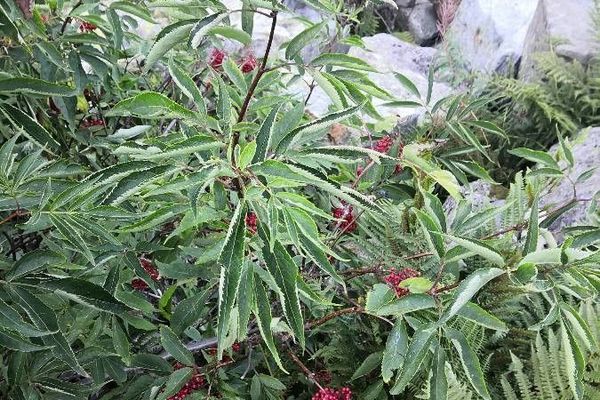
Опис
Tolerates most soils, including chalk, but prefers a moist loamy soil[11, 200]. Grows well in heavy clay soils. Tolerates some shade but is best in a sunny position. Tolerates atmospheric pollution and coastal situations. Closely related to S. racemosa and considered part of that species by some botanists. Plants in this genus are notably resistant to honey fungus. References Carbon Farming Information and Carbon Sequestration Information Temperature Converter Type a value in the Celsius field to convert the value to Fahrenheit: Celsius Fahrenheit: The PFAF Bookshop Plants For A Future have a number of books available in paperback and digital form. Book titles include Edible Plants , Edible Perennials , Edible Trees , Edible Shrubs , Woodland Gardening , and Temperate Food Forest Plants . Our new book is Food Forest Plants For Hotter Conditions (Tropical and Sub-Tropical) . Shop Now
Походження та ареал
NORTHERN AMERICA: Canada (Québec, Nova Scotia, Ontario, Prince Edward Island, New Brunswick, Newfoundland and Labrador, Alberta, Manitoba, British Columbia), United States (Alaska, Connecticut, Indiana, Maine, Massachusetts, Michigan, New Hampshire, New Jersey, New York, Ohio, Pennsylvania, Rhode Island, Vermont, West Virginia, Illinois, Iowa, Minnesota, Missouri, North Dakota, South Dakota, Wisconsin, Colorado, Idaho, Oregon, Washington, Kentucky, Maryland, North Carolina, Tennessee, Virginia,
Корисні властивості
Edible Parts: Flowers Fruit Edible Uses: Fruit - raw or cooked[105, 161, 257]. A bitter flavour. The fruit is quite nutritious, having a relatively high fat and protein as well as carbohydrate content. The fruit can be dried prior to use, it will then lose some of its rank taste. The fruit is about 5mm in diameter and is borne in large clusters making it easy to harvest. Some caution is advised, see the notes above on toxicity. Flowers - raw or cooked. The root is made into a tea-like beverage[105, 161, 183]. References More on Edible Uses
Поради
Seed - best sown as soon as it is ripe in the autumn in a cold frame, when it should germinate in early spring. Stored seed can be sown in the spring in a cold frame but will probably germinate better if it is given 2 months warm followed by 2 months cold stratification first[78, 98, 113]. Prick out the seedlings into individual pots when they are large enough to handle. If good growth is made, the young plants can be placed in their permanent positions during the early summer. Otherwise, either put them in a sheltered nursery bed, or keep them in their pots in a sheltered position and plant them out in spring of the following year. Cuttings of half-ripe wood, 7 - 10cm with a heel, July/August in a frame. Cuttings of mature wood of the current season's growth, 15 - 20cm with a heel, late autumn in a frame or a sheltered outdoor bed.