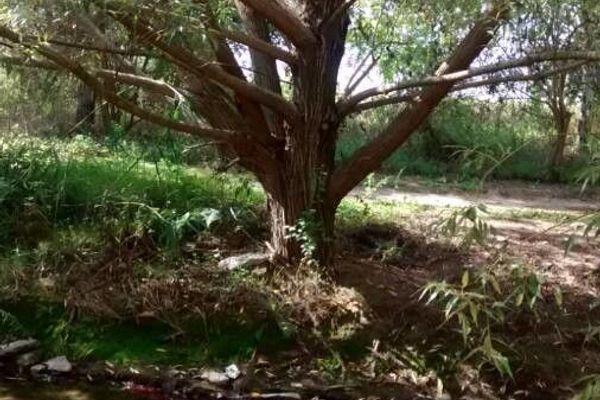
White willow
Salix alba
Родина: Salicaceae • Рід: Salix
БагаторічнаСередньоДекоративна
Main Bloom Time: Early spring, Mid spring. Form: Rounded, Upright or erect.
Опис
A very easily grown plant, it succeeds in most soils, including wet, ill-drained or intermittently flooded soils, but prefers a damp, heavy soil in a sunny position. Rarely thrives on chalk and dislikes poor thin soils. Very tolerant of maritime exposure and atmospheric pollution[75, 186]. Trees respond well to coppicing or pollarding. Best planted into its permanent position as soon as possible, trees respond badly to transplanting unless they are moved regularly. The root system is rather aggressive and can cause problems with drains. A very important food plant for the caterpillars of many species of butterflies and a good bee plant, providing an early source of nectar and pollen. A very good wildlife habitat, more than 200 species of insects are associated with this tree. There are many sub-species and cultivars in this species. S. alba caerulea is the cricket bat willow, cultivated for its wood[11, 131]. S. alba vitellina. (L.)Stokes. has been cultivated for its very tough stems that are used as tie rods in basket making[123, 131]. The cultivar 'Cardinal' is also grown for its use in basket making. This species is used commercially in papermaking. Hybridizes freely with other members of this genus, especially S. fragilis, to which it is closely related. Trees cast a relatively light shade. Dioecious. Male and female plants must be grown if seed is required. Special Features: Attractive foliage, Not North American native, Wetlands plant, Inconspicuous flowers or blooms. References Carbon Farming Information and Carbon Sequestration Information Temperature Converter Type a value in the Celsius field to convert the value to Fahrenheit: Celsius Fahrenheit: The PFAF Bookshop Plants For A Future have a number of books available in paperback and digital form. Book titles include Edible Plants , Edible Perennials , Edible Trees , Edible Shrubs , Woodland Gardening , and Temperate Food Forest Plants . Our new book is Food Forest Plants For Hotter Conditions (Tropical and Sub-Tropical) . Shop Now
Походження та ареал
TEMPERATE ASIA: Cyprus, Iran, Iraq, Israel, Jordan, Lebanon, Syria, Turkey, Russian Federation-Ciscaucasia (Ciscaucasia), Armenia, Azerbaijan, Georgia, Russian Federation (Dagestan), Russian Federation-Western Siberia (Western Siberia), Kazakhstan, Kyrgyzstan, Tajikistan, Turkmenistan, Uzbekistan, China (Gansu Sheng, Qinghai Sheng, Xinjiang Uygur Zizhiqu, Xizang Zizhiqu) EUROPE: Austria, Belgium, Switzerland, Czech Republic, Germany, Hungary, Netherlands, Poland, Slovakia, Russian Federation (Eu
Корисні властивості
Edible Parts: Inner bark Leaves Shoots Edible Uses: Tea Inner bark - raw or cooked. It can be dried, ground into a powder and added to cereal flour then used in making bread etc. A very bitter flavour, especially when fresh[2, 115], it is used as a famine food when all else fails. Leaves and young shoots - raw or cooked[2, 177]. Not very palatable. They are used only in times of scarcity. The leaves can be used as a tea substitute. References More on Edible Uses
Поради
Seed - must be surface sown as soon as it is ripe in late spring. It has a very short viability, perhaps as little as a few days. Cuttings of mature wood of the current year's growth, November to February in a sheltered outdoor bed or planted straight into their permanent position and given a good weed-suppressing mulch. Branches of older wood as long as 2.5 metres can be used. Very easy. Plant into their permanent positions in the autumn. Cuttings of half-ripe wood, June to August in a frame. Very easy.