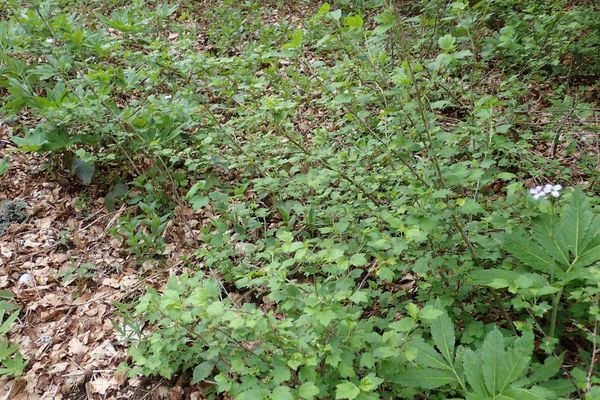
Alpine currant
Ribes alpinum
Родина: Grossulariaceae • Рід: Ribes
БагаторічнаСередньоДекоративна
Bloom Color: Green, Yellow. Main Bloom Time: Early spring, Late spring, Mid spring. Form: Spreading or horizontal, Upright or erect.
Опис
Landscape Uses:Erosion control, Foundation, Ground cover, Massing, Rock garden, Seashore. Easily grown in a moisture retentive but well-drained loamy soil of at least moderate quality[11, 200]. This species succeeds on poor soils. Does well in shade though it does not fruit so well in such a position. A very hardy plant, tolerating temperatures down to about -25°c. A number of named varieties have been developed for their ornamental value. The flowers are sweetly fragrant. Plants are dioecious. At least one male plant must be grown in the vicinity of up to 5 females if fruit is required. Plants can harbour a stage of white pine blister rust, so should not be grown in the vicinity of pine trees. Plants in this genus are notably susceptible to honey fungus. Special Features: Not North American native, Inconspicuous flowers or blooms. References Carbon Farming Information and Carbon Sequestration Information Temperature Converter Type a value in the Celsius field to convert the value to Fahrenheit: Celsius Fahrenheit: The PFAF Bookshop Plants For A Future have a number of books available in paperback and digital form. Book titles include Edible Plants , Edible Perennials , Edible Trees , Edible Shrubs , Woodland Gardening , and Temperate Food Forest Plants . Our new book is Food Forest Plants For Hotter Conditions (Tropical and Sub-Tropical) . Shop Now
Походження та ареал
TEMPERATE ASIA: Turkey (northeast), Russian Federation-Ciscaucasia (Ciscaucasia), Armenia, Georgia EUROPE: Denmark, Finland, United Kingdom, Norway, Sweden, Austria, Switzerland, Czech Republic, Germany, Hungary, Poland, Slovakia, Russian Federation-European part (European part (northwest)), Belarus, Estonia, Lithuania, Latvia, Ukraine, Albania, Bulgaria, Bosnia and Herzegovina, Croatia, Italy, North Macedonia, Montenegro, Romania, Serbia, Slovenia, Spain, France AFRICA: Morocco
Корисні властивості
Edible Parts: Fruit Edible Uses: Fruit - raw or cooked. Sweet and not very acid, but less palatable than R. rubrum, the red currant. An insipid fruit, it is not palatable[1, 11]. The only fruits we have eaten have been good size red currants with a fair flavour[K]. The fruit is about 5mm in diameter and can be freely borne when male and female plants are grown[K]. References More on Edible Uses
Поради
Seed - best sown as soon as it is ripe in the autumn in a cold frame. Stored seed requires 3 months cold stratification at 0 - 9°c and should be sown as early in the year as possible[113, 164]. Under normal storage conditions the seed can remain viable for 17 years or more. Prick out the seedlings into individual pots when they are large enough to handle and grow them on in a cold frame for their first winter, planting them out in late spring of the following year. Cuttings of half-ripe wood, July/August in a frame. Cuttings of mature wood of the current year's growth, preferably with a heel of the previous year's growth, November to February in a cold frame or sheltered bed outdoors[78, 200].