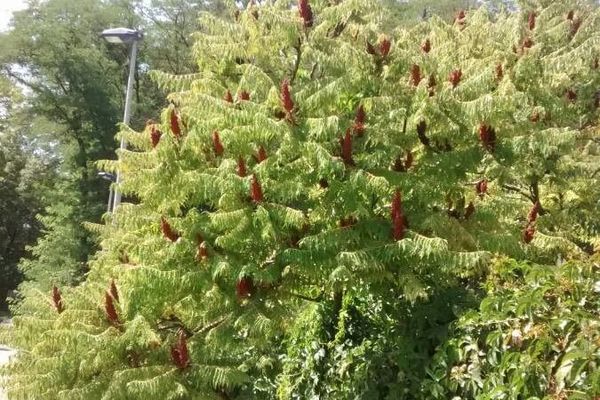
Опис
Landscape Uses:Border, Massing, Specimen. Succeeds in a well-drained fertile soil in full sun[11, 200]. Tolerates poor soils[169, 200]. Succeeds in dry soils and is drought resistant once it is established. A fairly wind hardy plant, though the branches are brittle and can be broken off in very high winds[200, K]. A very hardy plant, when fully dormant it can tolerate temperatures down to at least -25°c. However, the young growth in spring can be damaged by late frosts. A fast growing but short-lived tree, it can sucker freely, forming thickets and becoming quite anti-social when grown in small areas. Single-stem plants are short-lived in cultivation, but if the plants are coppiced regularly and allowed to form thickets, then they will live longer and also be more ornamental with larger leaves. Any coppicing is best carried out in early spring. A very ornamental plant, there are some named varieties. It is susceptible to coral spot fungus but is notably resistant to honey fungus[88, 200]. It transplants easily. This is a very good bee plant, the flowers producing an abundance of pollen and nectar. There is some doubt over the validity of this name and the earlier R. hirta. [L.] has been proposed as the correct name. However, it seems likely that R. typhina will be retained because it is so well known. This species is closely related to and hybridizes with R. glabra. Many of the species in this genus are highly toxic and can also cause severe irritation to the skin of some people, whilst other species such as this one are not poisonous. It is relatively simple to distinguish which is which, the poisonous species have axillary panicles and smooth fruits whilst non-poisonous species have compound terminal panicles and fruits covered with acid crimson hairs[1, 4]. The toxic species are sometimes separated into their own genus, Toxicodendron, by some botanists. Dioecious. Male and female plants must be grown if seed is required. Special Features: Attracts birds, North American native, Attractive flowers or blooms. For polyculture design as well as the above-ground architecture (form - tree, shrub etc. and size shown above) information on the habit and root pattern is also useful and given here if available. The plant growth habit is a running thicket former forming a colony from shoots away from the crown spreading indefinitely [1-2]. The root pattern is flat with shallow roots forming a plate near the soil surface [1-2]. The root pattern is suckering with new plants from underground runners away from the plant [1-2]. The berries are typically harvested in late summer to early autumn, around August to September (Northern Hemisphere), when they are fully ripe. Sumac generally flowers in early to mid-summer, usually from June to July (Northern Hemisphere). Sumac species typically grow at a moderate pace, reaching maturity within a few years, and can establish rapidly in suitable conditions. References Carbon Farming Information and Carbon Sequestration Information Temperature Converter Type a value in the Celsius field to convert the value to Fahrenheit: Celsius Fahrenheit: The PFAF Bookshop Plants For A Future have a number of books available in paperback and digital form. Book titles include Edible Plants , Edible Perennials , Edible Trees , Edible Shrubs , Woodland Gardening , and Temperate Food Forest Plants . Our new book is Food Forest Plants For Hotter Conditions (Tropical and Sub-Tropical) . Shop Now
Походження та ареал
NORTHERN AMERICA: Canada, Québec, Nova Scotia, Ontario, Prince Edward Island, New Brunswick, United States, Connecticut, Indiana, Maine, Massachusetts, Michigan, New Hampshire, New Jersey, New York, Ohio, Pennsylvania, Rhode Island, Vermont, West Virginia, Illinois, Iowa, Minnesota, Wisconsin, Alabama (north), Delaware, Georgia (north), Kentucky, Maryland, North Carolina, South Carolina, Tennessee, Virginia,
Корисні властивості
Edible Parts: Fruit Oil Edible Uses: Drink Oil Fruit - cooked[22, 62]. A very sour flavour, they are used in pies. The fruit is rather small and with very little flesh, but it is produced in quite large clusters and so is easily harvested. When soaked for 10 - 30 minutes in hot or cold water it makes a very refreshing lemonade-like drink (without any fizz of course)[55, 85, 95. 101, 102, 183]. The mixture should not be boiled since this will release tannic acids and make the drink astringent. References More on Edible Uses
Поради
Seed - best sown in a cold frame as soon as it is ripe. Pre-soak the seed for 24 hours in hot water (starting at a temperature of 80 - 90c and allowing it to cool) prior to sowing in order to leach out any germination inhibitors. This soak water can be drunk and has a delicious lemon-flavour. The stored seed also needs hot water treatment and can be sown in early spring in a cold frame. When they are large enough to handle, prick the seedlings out into individual pots and grow them on in the greenhouse for their first winter. Plant them out into their permanent positions in late spring or early summer, after the last expected frosts. Cuttings of half-ripe wood, 10cm with a heel, July/August in a frame. Root cuttings 4cm long taken in December and potted up vertically in a greenhouse. Good percentage[78, 200]. Suckers in late autumn to winter.