Опис
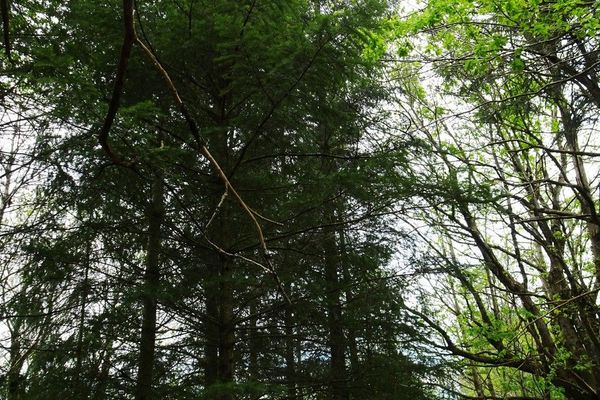
Landscape Uses:Christmas tree, Firewood, Aggressive surface roots possible, Screen, Specimen. Prefers a moist but not water-logged alluvial soil. Dislikes calcareous soils. Trees are a failure on dry hungry soils.. Whilst they are moderately wind resistant, tall specimens are likely to lose their crowns once they are more than 30 metres tall in all but the most sheltered areas. A very ornamental tree, it is the most cultivated timber tree in the world and is extensively used for re-afforestation in Britain. There are several named varieties selected for their ornamental value. Trees can be established in light shade but this must be removed in the first few years or growth will suffer. Very slow growing for its first few years, growth soon becomes extremely fast with new shoots of up to 1.2 metres a year. This annual increase can be maintained for many years. Trees in sheltered Scottish valleys have reached 55 metres in 100 years. New growth takes place from May to July. The trees require abundant rainfall for good growth[11, 49]. Trees should be planted into their permanent positions when they are quite small, between 30 and 90cm. Larger trees will check badly and hardly put on any growth for several years. This also badly affects root development and wind resistance. Trees are very long-lived, specimens over 1,000 years old are known. Seed production commences when trees are about 10 years old, though good production takes another 15 - 20 years. Good crops are produced about every 6 years. This tree is a pioneer species because it cannot reproduce under its own canopy. The bark on mature trees can be 30cm thick, and this insulates the trunks from the heat of forest fires. This species is notably resistant to honey fungus[81, 200]. Young growth can be damaged by late frosts. The leaves have a strong sweet fruity aroma. Special Features: North American native, Inconspicuous flowers or blooms. References Carbon Farming Information and Carbon Sequestration Information Temperature Converter Type a value in the Celsius field to convert the value to Fahrenheit: Celsius Fahrenheit: The PFAF Bookshop Plants For A Future have a number of books available in paperback and digital form. Book titles include Edible Plants , Edible Perennials , Edible Trees , Edible Shrubs , Woodland Gardening , and Temperate Food Forest Plants . Our new book is Food Forest Plants For Hotter Conditions (Tropical and Sub-Tropical) . Shop Now
Походження та ареал
NORTHERN AMERICA: Canada (Alberta (southwest), British Columbia), United States (Colorado, Idaho, Montana, Oregon, Washington, Wyoming, New Mexico, Texas, Arizona, California, Nevada, Utah), Mexico (Chihuahua, Coahuila de Zaragoza, Durango, Nuevo León, San Luis Potosí, Sinaloa, Sonora, Tamaulipas, Zacatecas, Guerrero, Hidalgo, México, Oaxaca, Puebla, Querétaro, Tlaxcala, Veracruz de Ignacio de la Llave)
Корисні властивості
Edible Parts: Inner bark Manna Shoots Edible Uses: Coffee Condiment Gum Tea Young shoot tips - used as a flavouring in cooked foods[15, 177]. A subtle woodsy flavour. A refreshing tea is made from the young leaves and twigs[14, 46, 177, 257]. Rich in vitamin C. It is used as a coffee substitute according to some reports[92, 95, 161, 257]. The fresh leaves have a pleasant balsamic odour and are used as a coffee substitute. Inner bark - dried, ground into a meal and mixed with cereals for making bread etc[161, 213]. A famine food used when all else fails. A sweet manna-like substance is exuded from the bark[177, 183]. This report possibly refers to the resin that is obtained from the trunk[K], and is used as a chewing gum by various native North American Indian tribes. Alternatively, the report could be referring to the sap which is used as a sugar-like food. References More on Edible Uses
Поради
Seed - best sown in the autumn to winter in a cold frame so that it is stratified. The seed can also be stored dry and sown in late winter. When they are large enough to handle, prick the seedlings out into individual pots and grow them on in light shade in the cold frame for at least their first winter. Plant them out into their permanent positions in late spring or early summer, after the last expected frosts. Seedlings tolerate light shade for their first few years of growth. Cones often fall from the tree with their seed still inside. If you have plenty of seed then it can be sown in an outdoor seedbed in early spring. Grow the plants on for at least two years in the seedbed before planting them out in late autumn or early spring.