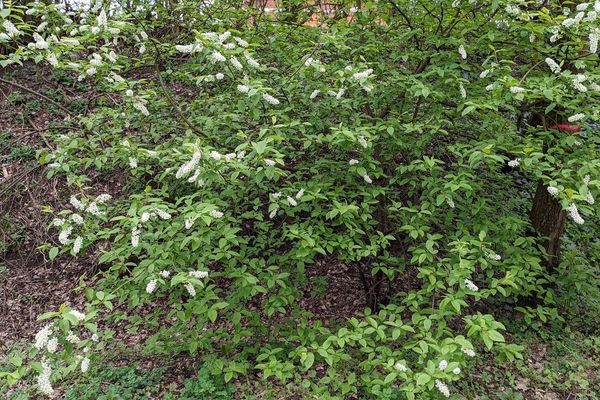
European bird cherry
Prunus padus
Родина: Rosaceae • Рід: Prunus
БагаторічнаСередньоДекоративна
Bloom Color: White. Main Bloom Time: Early winter, Late winter, Mid winter. Form: Rounded, Vase.
Опис
Landscape Uses:Specimen. Succeeds in any soil, preferring a well-drained moisture-retentive loamy soil[11, 200]. Prefers some lime in the soil but is likely to become chlorotic if too much lime is present. Succeeds in sun or partial shade though it fruits better in a sunny position[11, 200]. Very hardy but it does not like exposure to strong winds. A very hardy tree[1, 11], tolerating temperatures down to about -30°c. A very ornamental species, there are some named varieties. The sub-species P. padus borealis is found in Scandinavia and the mountains of C. Europe. It is a shrub growing only to about 3 metres high. Most members of this genus are shallow-rooted and will produce suckers if the roots are damaged. Trees usually produce lots of suckers and will soon regenerate by this method if the main trunk is cut down. This tree is a host for cereal virus vector. Plants in this genus are notably susceptible to honey fungus. Trees only cast a light shade and do not themselves thrive in heavy shade. The fruits are relished by birds and the flowers and leaves attract many insects. Special Features: Not North American native, Fragrant flowers, Blooms are very showy. In garden design, as well as the above-ground architecture of a plant, root structure considerations help in choosing plants that work together for their optimal soil requirements including nutrients and water. The root pattern is flat with shallow roots spreading near the soil surface. The root pattern is suckering with new plants from runners away from the plant [2-1]. References Carbon Farming Information and Carbon Sequestration Information Temperature Converter Type a value in the Celsius field to convert the value to Fahrenheit: Celsius Fahrenheit: The PFAF Bookshop Plants For A Future have a number of books available in paperback and digital form. Book titles include Edible Plants , Edible Perennials , Edible Trees , Edible Shrubs , Woodland Gardening , and Temperate Food Forest Plants . Our new book is Food Forest Plants For Hotter Conditions (Tropical and Sub-Tropical) . Shop Now
Походження та ареал
TEMPERATE ASIA: Turkey, Armenia, Georgia, Russian Federation-Western Siberia (Western Siberia), Russian Federation-Eastern Siberia (Eastern Siberia), Kazakhstan, Mongolia, Russian Federation-Far East (Far East), China (Gansu Sheng, Hebei Sheng, Heilongjiang Sheng, Henan Sheng, Jilin Sheng, Liaoning Sheng, Nei Mongol Zizhiqu, Qinghai Sheng, Shaanxi Sheng, Shandong Sheng, Shanxi Sheng, Xinjiang Uygur Zizhiqu), Korea, Japan (Hokkaidô) EUROPE: Denmark, Finland, United Kingdom, Ireland, Norway, Swede
Корисні властивості
Edible Parts: Flowers Fruit Leaves Seed Edible Uses: Tea Fruit - raw or cooked[2, 5, 13, 46]. The fruit usually has a bitter taste and is used mainly for making jam and preserves[11, 183]. The fruit is about the size of a pea and contains one large seed. Flowers - chewed[177, 183]. Young leaves - cooked. Used as a boiled vegetable in Korea. Seed - raw or cooked. Do not eat the seed if it is too bitter - see the notes above on toxicity. A tea is made from the bark. References More on Edible Uses
Поради
Seed - requires 2 - 3 months cold stratification and is best sown in a cold frame as soon as it is ripe. Sow stored seed in a cold frame as early in the year as possible. Protect the seed from mice etc. The seed can be rather slow, sometimes taking 18 months to germinate. Prick out the seedlings into individual pots when they are large enough to handle. Grow them on in a greenhouse or cold frame for their first winter and plant them out in late spring or early summer of the following year. Cuttings of half-ripe wood with a heel, July/August in a frame. Softwood cuttings from strongly growing plants in spring to early summer in a frame. Cuttings of mature wood, October/November in a frame. Suckers removed in late winter. Layering in spring.