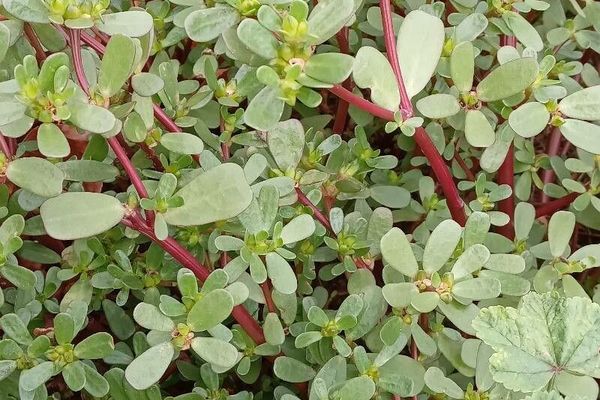
Common purslane
Portulaca oleracea
Родина: Portulacaceae • Рід: Portulaca
БагаторічнаСередньоДекоративна
Опис
Requires a moist light rich well-drained soil in a sunny position[4, 37, 200]. Plants will not produce good quality leaves when growing in dry conditions. A perennial plant in warmer climates than Britain, purslane is killed by frost but can be grown as a half-hardy annual in this country. It can become an aggressive weed in areas where the climate suits it. The flowers only open in full sunlight. Purslane is occasionally cultivated for its edible leaves, there are some named varieties. The plants take about six to eight weeks to produce a crop from seed and can then be harvested on a cut and come again principle, providing edible leaves for most of the summer. References Carbon Farming Information and Carbon Sequestration Information Temperature Converter Type a value in the Celsius field to convert the value to Fahrenheit: Celsius Fahrenheit: The PFAF Bookshop Plants For A Future have a number of books available in paperback and digital form. Book titles include Edible Plants , Edible Perennials , Edible Trees , Edible Shrubs , Woodland Gardening , and Temperate Food Forest Plants . Our new book is Food Forest Plants For Hotter Conditions (Tropical and Sub-Tropical) . Shop Now
Походження та ареал
Coming Soon
Корисні властивості
Edible Parts: Leaves Seed Edible Uses: Salt Leaves and stems - raw or cooked[1, 4, 12, 27, 37]. The young leaves are a very acceptable addition to salads, their mucilaginous quality also making them a good substitute for okra as a thickener in soups[4, 183]. Older leaves are used as a potherb. The leaves have a somewhat sour flavour. A spicy and somewhat salty taste. The leaves are a source of omega-3 fatty acids, though seed sources such as walnuts are magnitudes richer. The leaves can be dried for later use. They contain about 1.8% protein, 0.5% fat, 6.5% carbohydrate, 2.2% ash. Another analysis gives the following figures per 100g ZMB. 245 - 296 calories, 17.6 - 34.5g protein, 2.4 - 5.3g fat, 35.5 - 63.2g carbohydrate, 8.5 - 14.6g fibre, 15.9 - 24.7g ash, 898 - 2078mg calcium, 320 - 774mg phosphorus, 11.2 - 46.7mg iron, 55mg sodium, 505 - 3120mg potassium, 10560 - 20000ug B-carotene equivalent, 0.23 - 0.48mg thiamine, 1.12 - 1.6mg riboflavin, 5.58 - 6.72mg niacin and 168 - 333mg ascorbic acid. Seed - raw or cooked[62, 102, 159]. The seed can be ground into a powder and mixed with cereals for use in gruels, bread, pancakes etc[183, 193]. The seed is rather small and fiddly to utilize. In arid areas of Australia the plants grow quite large and can produce 10, 000 seeds per plant, a person can harvest several pounds of seed in a day. The seeding plants are uprooted and placed in a pile on sheets or something similar, in a few days the seeds are shed and can be collected from the sheet. In Britain, however, yields are likely to be very low, especially in cool or wet summers[K]. The seed contains (per 100g ZMB) 21g protein, 18.9g fat 3.4g ash. Fatty acids of the seeds are 10.9% palmitic, 3.7% stearic, 1.3% behenic, 28.7% oleic, 38.9% linoleic and 9.9% linolenic. The ash of burnt plants is used as a salt substitute. References More on Edible Uses Composition Figures in grams (g) or miligrams (mg) per 100g of food. Leaves (Dry weight) 270 Calories per 100g Water : 0% Protein: 26g; Fat: 4g; Carbohydrate: 50g; Fibre: 11.5g; Ash: 20g; Minerals - Calcium: 1500mg; Phosphorus: 550mg; Iron: 29mg; Magnesium: 0mg; Sodium: 55mg; Potassium: 1800mg; Zinc: 0mg; Vitamins - A: 15000mg; Thiamine (B1): 0.35mg; Riboflavin (B2): 1.4mg; Niacin: 6mg; B6: 0mg; C: 250mg; Reference: [ 218] Notes: The figures given here are the median of a very wide range quoted in the report.
Поради
Seed - for an early crop, the seed is best sown under protection in early spring and can then be planted out in late spring. Outdoor sowings in situ take place from late spring to late summer, successional sowings being made every two to three weeks if a constant supply of the leaves is required.