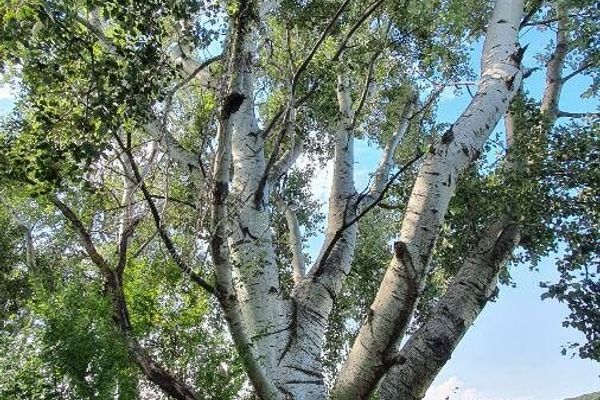
Silverleaf poplar
Populus alba
Родина: Salicaceae • Рід: Populus
БагаторічнаСередньоДекоративна
Bloom Color: Yellow. Main Bloom Time: Early spring, Late spring, Mid spring. Form: Oval.
Опис
Landscape Uses:Erosion control, Aggressive surface roots possible, Specimen. An easily grown plant, it does well in a heavy cold damp soil. Prefers a deep rich well-drained circumneutral soil, growing best in the south and east of Britain[11, 200]. Growth is much less on wet soils, on poor acid soils and on thin dry soils. This species thrives on drier soils than other members of the genus. It does not do well in exposed upland sites but it is tolerant of maritime exposure, though it can be wind pruned in such a situation[11, 200]. Dislikes shade, it is intolerant of root or branch competition. Tolerates both hot and cool summers. A very ornamental tree, it is fast-growing but fairly short-lived[1, 11, 227]. There are several named varieties. An important food plant for the caterpillars of many species of butterflies. The leaf buds are resinous and exude an aromatic perfume in the spring. Poplars have very extensive and aggressive root systems that can invade and damage drainage systems. Especially when grown on clay soils, they should not be planted within 12 metres of buildings since the root system can damage the building's foundations by drying out the soil. Dioecious. Male and female plants must be grown if seed is required. Hybridizes freely with other members of this genus. Special Features: Not North American native, Invasive, Inconspicuous flowers or blooms. References Carbon Farming Information and Carbon Sequestration Information Temperature Converter Type a value in the Celsius field to convert the value to Fahrenheit: Celsius Fahrenheit: The PFAF Bookshop Plants For A Future have a number of books available in paperback and digital form. Book titles include Edible Plants , Edible Perennials , Edible Trees , Edible Shrubs , Woodland Gardening , and Temperate Food Forest Plants . Our new book is Food Forest Plants For Hotter Conditions (Tropical and Sub-Tropical) . Shop Now
Походження та ареал
TEMPERATE ASIA: Jordan, Lebanon, Turkey, Russian Federation-Ciscaucasia (Ciscaucasia), Georgia, Russian Federation-Western Siberia (Western Siberia (south)), Kazakhstan, Turkmenistan, Uzbekistan, China (Xinjiang Uygur Zizhiqu) EUROPE: Austria, Switzerland, Czech Republic, Germany, Hungary, Poland, Slovakia, Russian Federation-European part (European part (south)), Belarus, Ukraine (incl. Krym), Albania, Bulgaria, Bosnia and Herzegovina, Greece, Croatia, Italy (incl. Sardinia, Sicily), Montenegro
Корисні властивості
Edible Parts: Inner bark Leaves Edible Uses: Leaves - rich in Vitamin C. Inner bark - dried, ground into a powder and added to flour for making bread[2, 105]. A famine food, it is only used when all else fails. References More on Edible Uses
Поради
Seed - must be sown as soon as it is ripe in spring. Poplar seed has an extremely short period of viability and needs to be sown within a few days of ripening. Surface sow or just lightly cover the seed in trays in a cold frame. Prick out the seedlings into individual pots when they are large enough to handle and grow them on in the cold frame. If sufficient growth is made, it might be possible to plant them out in late summer into their permanent positions, otherwise keep them in the cold frame until the following late spring and then plant them out. This species does not often produce viable seed in Britain. Most poplar species hybridize freely with each other, so the seed may not come true unless it is collected from the wild in areas with no other poplar species growing. Cuttings of mature wood of the current season's growth, 20 - 40cm long, November/December in a sheltered outdoor bed or direct into their permanent positions. Very easy. Suckers in early spring.