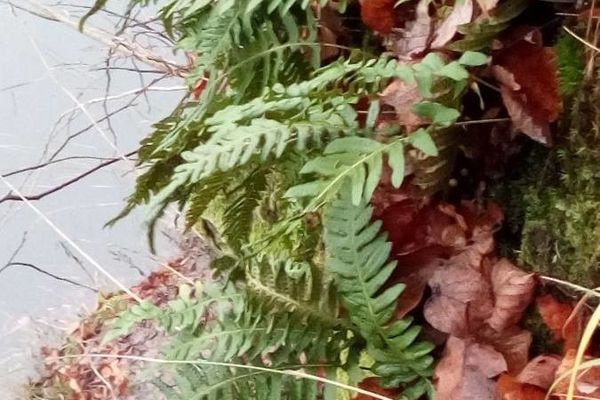
Common polypody
Polypodium vulgare
Родина: Polypodiaceae • Рід: Polypodium
БагаторічнаСередньоДекоративна
Form: Irregular or sprawling, Rounded, Upright or erect.
Опис
Landscape Uses:Border, Container, Erosion control, Foundation, Ground cover, Massing, Rock garden, Woodland garden. Easily grown in most light soils. Prefers a soil of leaf mould and a cool but not too moist clay. Prefers a cool damp shady position. Thrives in dry shade[28, 188]. Established plants are drought tolerant. They grow well on drystone walls. Plants often grow as epiphytes[28, 31]. Members of this genus are rarely if ever troubled by browsing deer. A rather variable plant, it is considered to be an aggregate species of several very similar species. Only the roots should be planted, the rhizome being fixed to the surface of the soil[1, 187]. Special Features: Attractive foliage, Not North American native, There are no flowers or blooms. Polypodium virginianum (Polypodium vulgare subsp. virginianum (L.) Hultén is a synonym of Polypodium virginianum L.) commonly know as rock cap fern, or common polypody tolerates hardiness zones down to 3. It prefers acidic soil. It is a small evergreen species of fern native to the Eastern United States and Canada. It generally grows on rocks and occasionally on tree roots in nature. A small rhizomatous fern with narrow leaves 8–40 centimetres (3.1–15.7 in) long and 3–6 centimetres (1.2–2.4 in) wide. Polypodium virginianum typically grows on boulders, cliffs, and rocky slopes and does not need well-developed soil. The plant is heat tolerant in zones 9 through 1. (Plant Hardiness Zones show how well plants withstand cold winter temperatures. Plant Heat Zones show when plants would start suffering from the heat. The Plant Heat Zone map is based on the number of "heat days" experienced in a given area where the temperature climbs to over 86 degrees F (30°C). At this temperature, many plants begin to suffer physiological damage. Heat Zones range from 1 (no heat days) to 12 (210 or more heat days). For example Heat Zone. 11-1 indicates that the plant is heat tolerant in zones 11 through 1.) For polyculture design as well as the above-ground architecture (form - tree, shrub etc. and size shown above) information on the habit and root pattern is also useful and given here if available. The plant growth habit is a clumper with limited spread [1-2]. The root pattern is rhizomatous with underground stems sending roots and shoots along their length [1-2]. References Carbon Farming Information and Carbon Sequestration Information Temperature Converter Type a value in the Celsius field to convert the value to Fahrenheit: Celsius Fahrenheit: The PFAF Bookshop Plants For A Future have a number of books available in paperback and digital form. Book titles include Edible Plants , Edible Perennials , Edible Trees , Edible Shrubs , Woodland Gardening , and Temperate Food Forest Plants . Our new book is Food Forest Plants For Hotter Conditions (Tropical and Sub-Tropical) . Shop Now
Походження та ареал
TEMPERATE ASIA: Armenia, Azerbaijan, Ciscaucasia, Dagestan, Georgia, Hokkaidô, Honshu, Japan, Kazakhstan, Kyrgyzstan, Russian Federation, Russian Federation-Ciscaucasia, Russian Federation-Western Siberia, Turkey, Western Siberia,Iran. NORTHERN AMERICA: Greenland, EUROPE: Denmark, Finland, United Kingdom (U.K.), Ireland, Iceland, Norway, Austria, Belgium, Switzerland, Czech Republic, Germany, Hungary, Netherlands, Poland, Slovakia, Russian Federation-European part, European part, Lithuania, Latv
Корисні властивості
Edible Parts: Root Edible Uses: Root. Very sweet, it contains sugars, tannin and oils. It is used as a liquorice adulterant. The root has a unique, rather unpleasant odour and a sweet (cloying) flavour at first though it quickly becomes nauseating. The root contains 15.5% saccharose and 4.2% glucose. References More on Edible Uses
Поради
Spores - best sown as soon as they are ripe, though they can also be sown in the spring. Sow them on the surface of a humus-rich sterilized soil. Keep the compost moist, preferably by putting a plastic bag over the pot. Pot on small clumps of plantlets as soon as they are large enough to handle and keep humid until they are well established. Do not plant outside until the ferns are at least 2 years old and then only in a very well sheltered position. Division. This is best done in the spring but it succeeds at most times of the year.