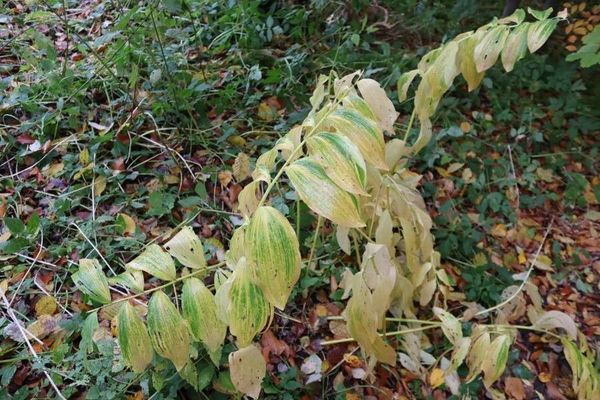
Solomon's-seal
Polygonatum multiflorum
Родина: Asparagaceae • Рід: Polygonatum
БагаторічнаСередньоДекоративна
Опис
Prefers a fertile humus rich moisture retentive well-drained soil in cool shade or semi-shade. Succeeds in dry shade if the soil is rich in humus. Grows well in heavy clay soils. Plants are intolerant of heat and drought but tolerate most other conditions. Another report suggests that they tolerate drought so long as the soil is rich in humus. A very ornamental plant, growing well on the woodland edge. There are some named forms. Members of this genus are rarely if ever troubled by browsing deer or rabbits. The young shoots of most members of this genus are very attractive to slugs[K]. Hybridizes with other members of this genus. References Carbon Farming Information and Carbon Sequestration Information Temperature Converter Type a value in the Celsius field to convert the value to Fahrenheit: Celsius Fahrenheit: The PFAF Bookshop Plants For A Future have a number of books available in paperback and digital form. Book titles include Edible Plants , Edible Perennials , Edible Trees , Edible Shrubs , Woodland Gardening , and Temperate Food Forest Plants . Our new book is Food Forest Plants For Hotter Conditions (Tropical and Sub-Tropical) . Shop Now
Походження та ареал
TEMPERATE ASIA: Turkey, Russian Federation-Ciscaucasia (Ciscaucasia) TROPICAL ASIA: Nepal EUROPE: Denmark, Finland, United Kingdom, Norway, Czechoslovakia, Austria, Belgium, Switzerland, Germany, Hungary, Netherlands, Poland, Russian Federation (European part), Belarus, Russian Federation (Saratov, Volgogradskaja oblast), Ukraine, Former Yugoslavia, Albania, Bulgaria, Greece, Italy, Romania, Spain, France
Корисні властивості
Edible Parts: Leaves Root Shoots Edible Uses: Young shoots - cooked. Boiled and used as an asparagus substitute, they make an excellent vegetable[2, 4, 115] and are widely used in Turkey. Root - cooked[177, 179]. Rich in starch. The root should be macerated for some time in water in order to remove bitter substances. Normally only used in times of famine, the root was powdered and then made into a bread by the North American Indians. References More on Edible Uses
Поради
Seed - best sown as soon as it is ripe in early autumn in a shady part of a cold greenhouse. Sow stored seed as early in the year as possible. Germination can be slow, they may not come true to type and it takes a few years for them to reach a good size. When they are large enough to handle, prick the seedlings out into individual pots and grow them on in a shady position in the greenhouse for at least their first winter. Plant them out into their permanent positions in late spring or early summer, after the last expected frosts. Division in March or October. Larger divisions can be planted out direct into their permanent positions. We have found that it is better to pot up the smaller divisions and grow them on in light shade in a cold frame until they are well established before planting them out in late spring or early summer.