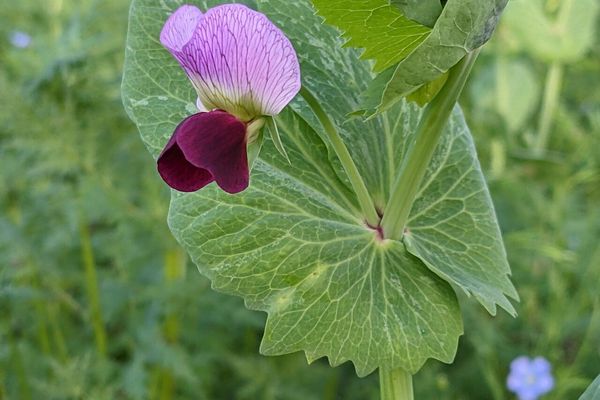
Опис
Requires a well-drained moisture retentive soil[1, 16, 37]. Prefers a calcareous soil. Prefers a pH in the range 6 to 7.5. Prefers a rich loamy soil. A light soil and a sheltered position is best for early sowings. Peas have long been cultivated as a food crop and a number of distinct forms have emerged which have been classified as follows. A separate record has been made for each form:- P. sativum. The garden pea, including petit pois. Widely cultivated for its sweet-tasting edible immature seeds, as well as the immature seedpods and mature seeds, there are many named varieties and these can provide a crop from May to October. P. sativum arvense. The field pea. Hardier than the garden pea, but not of such good culinary value, it is more often grown as a green manure or for the dried seeds. P. sativum elatius. This is the original form of the species and is still found growing wild in Turkey. P. sativum elatius pumilio. A short, small-flowered form of the above. P. sativum macrocarpon. The edible-pod pea has a swollen, fibre-free and very sweet seedpod which is eaten when immature. The garden pea is widely cultivated and there are many named varieties. There are two basic types of varieties, those with round seeds and those with wrinkled seeds. Round seeded varieties are hardier and can be sown in the autumn to provide an early crop in May or June, wrinkled varieties are sweeter and tastier but are not so hardy and are sown in spring to early summer. Within these two categories, there are dwarf cultivars and climbing cultivars, the taller types tend to yield more heavily and for a longer period but smaller forms are easier to grow, often do not need supports and can give heavier crops from the area of land used (though less from each plant). Cultivars developed for their edible young seeds tend to have pods containing a lot of fibre but some cultivars have now been selected for their larger and fibre-free pods - these cultivars are harder to grow for their seed, especially in damp climates, because the seed has a greater tendency to rot in wet weather. Peas are good growing companions for radishes, carrots, cucumbers, sweet corn, beans and turnips[18, 20, 201]. They are inhibited by alliums, gladiolus, fennel and strawberries growing nearby[18, 20, 201]. There is some evidence that if Chinese mustard (Brassica juncea) is grown as a green manure before sowing peas this will reduce the incidence of soil-borne root rots. This species has a symbiotic relationship with certain soil bacteria, these bacteria form nodules on the roots and fix atmospheric nitrogen. Some of this nitrogen is utilized by the growing plant but some can also be used by other plants growing nearby. When removing plant remains at the end of the growing season, it is best to only remove the aerial parts of the plant, leaving the roots in the ground to decay and release their nitrogen. Pisum sativum (common pea) is typically grown as a cool-season annual and is suited to USDA Hardiness Zones 2 through 9. It is not frost-tender during early stages and can be sown very early in spring, often as soon as the soil is workable. In warmer zones (8–9), it can also be grown as a fall or winter crop, as peas prefer cool temperatures and tend to struggle in the heat of summer. While not a perennial, the plant can tolerate light frosts, especially before flowering. Because of its adaptability and short growing season, Pisum sativum is widely cultivated across a broad range of temperate climates. References Carbon Farming Information and Carbon Sequestration Information Temperature Converter Type a value in the Celsius field to convert the value to Fahrenheit: Celsius Fahrenheit: The PFAF Bookshop Plants For A Future have a number of books available in paperback and digital form. Book titles include Edible Plants , Edible Perennials , Edible Trees , Edible Shrubs , Woodland Gardening , and Temperate Food Forest Plants . Our new book is Food Forest Plants For Hotter Conditions (Tropical and Sub-Tropical) . Shop Now
Походження та ареал
TEMPERATE ASIA: Cyprus, Iran, Iraq (north), Israel, Lebanon, Syria (west), Turkey, Russian Federation-Ciscaucasia (Ciscaucasia), Armenia, Azerbaijan, Georgia EUROPE: Moldova, Ukraine (incl. Krym), Former Yugoslavia, Albania, Bulgaria, Greece (incl. Crete), Italy (incl. Sardinia, Sicily), Romania, Spain, France (incl. Corsica), Portugal AFRICA: Algeria, Egypt, Libya, Morocco, Tunisia, Ethiopia
Корисні властивості
Edible Parts: Leaves Seed Shoots Edible Uses: Immature seedpods - raw or cooked[1, 2, 13, 16, 46]. The young seedpods have a sweet flavour, but there is only a thin layer of flesh with a fibrous layer beneath it. Immature seeds - raw or cooked. Sweet and delicious, they can be added to salads, or lightly cooked[K]. A nutritional analysis is available. The mature seeds are rich in protein and can be cooked as a vegetable or added to soups etc. They can also be sprouted and added to salads, soups etc. The mature seed can also be dried and ground into a powder, then used to enrich the protein content of flour when making bread etc[K]. The roasted seed is a coffee substitute. Leaves and young shoots - cooked and used as a potherb[177, 183]. The young shoots taste like fresh peas, they are exceptionally tender and can be used in salads. References More on Edible Uses Composition Figures in grams (g) or miligrams (mg) per 100g of food. Green seed (Fresh weight) 44 Calories per 100g Water : 76.5% Protein: 6.2g; Fat: 0.4g; Carbohydrate: 16.9g; Fibre: 2.4g; Ash: 0.9g; Minerals - Calcium: 32mg; Phosphorus: 102mg; Iron: 1.2mg; Magnesium: 0mg; Sodium: 6mg; Potassium: 350mg; Zinc: 0mg; Vitamins - A: 405mg; Thiamine (B1): 0.28mg; Riboflavin (B2): 0.11mg; Niacin: 2.8mg; B6: 0mg; C: 27mg; Reference: [ 218] Notes:
Поради
Pre-soak the seed for 24 hours in warm water and then sow in situ in succession from late winter until early summer. A minimum temperature of 10°c is required for germination, which should take place in about 7 - 10 days. The earlier sowings should be of suitably hardy varieties, the 'round seeded', whilst later sowings can be of the tastier varieties, the 'wrinkle seeded'. By making fresh sowings every 3 weeks you will have a continuous supply of fresh young seeds from early summer until early autumn. If you want to grow the peas to maturity then the seed needs to be sown by the middle of spring. You may need to protect the seed from the ravages of mice. Another sowing can be made in middle to late autumn. This has to be timed according to the area where the plants are being grown. The idea is that the plants will make some growth in the autumn and be perhaps 15 - 20cm tall by the time the colder part of winter sets in. As long as the winter is not too severe, the plants should stand well and will grow away rapidly in the spring to produce an earlier crop. Make sure you choose a suitably hardy variety for this sowing.