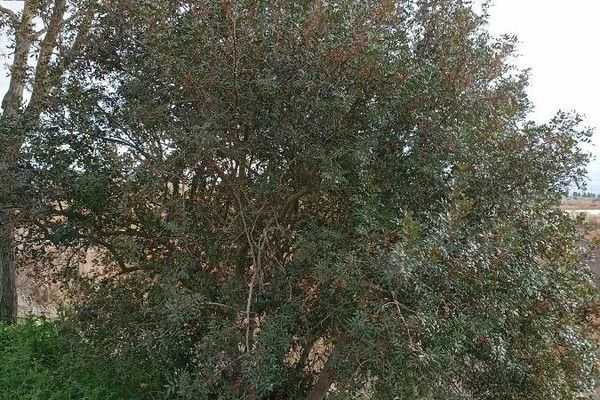
Chios mastictree
Pistacia lentiscus
Родина: Anacardiaceae • Рід: Pistacia
БагаторічнаСередньоДекоративна
Bloom Color: Green. Main Bloom Time: Late spring, Mid spring. Form: Rounded, Spreading or horizontal.
Опис
Industrial Crop: Hydrocarbon Management: Standard Regional Crop Landscape Uses:Border, Container, Erosion control, Screen, Specimen. Succeeds in any ordinary garden soil[1, 11], preferring a hot dry position in full sun. Prefers a well-drained to dry sandy or stony alkaline soil. This species is not very hardy in Britain. It normally requires the protection of a south-facing wall[11, 200] but can succeed in a hot dry position in the milder areas of the country. The mastic tree is cultivated in southern Europe for its resin. It is a very variable plant, a form with broad leaves yielding the best resin. It is likely to need long hot and dry summers in order to yield its resin, and so is unlikely to produce it very freely in Britain. Any pruning that needs to be done is best carried out in the spring. Dioecious, male and female plants must be grown if seed is required. Special Features:Not North American native, Inconspicuous flowers or blooms. Carbon Farming Industrial Crop: Hydrocarbon Materials, chemicals and energy include bioplastics, rubber, biomass products gasoline, jet fuel, diesel, butane, propane, biogas. Plants are usually resprouting plants and saps. Management: Standard Plants grow to their standard height. Harvest fruit, seeds, or other products. Non-Destructive management systems. Regional Crop These crops have been domesticated and cultivated regionally but have not been adopted elsewhere and are typically not traded globally, Examples in this broad category include perennial cottons and many nuts and staple fruits. References Carbon Farming Information and Carbon Sequestration Information Temperature Converter Type a value in the Celsius field to convert the value to Fahrenheit: Celsius Fahrenheit: The PFAF Bookshop Plants For A Future have a number of books available in paperback and digital form. Book titles include Edible Plants , Edible Perennials , Edible Trees , Edible Shrubs , Woodland Gardening , and Temperate Food Forest Plants . Our new book is Food Forest Plants For Hotter Conditions (Tropical and Sub-Tropical) . Shop Now
Походження та ареал
TEMPERATE ASIA: Cyprus, Israel, Jordan, Lebanon, Syria (west), Turkey (west) EUROPE: Albania, Greece (incl. Crete), Croatia, Italy (incl. Sardinia, Sicily), Spain (incl. Baleares), France (s. & Corsica), Portugal AFRICA: Spain (Canarias), Algeria (north), Egypt (north), Libya (north), Morocco, Tunisia
Корисні властивості
Edible Parts: Oil Oil Edible Uses: Condiment Gum Oil Oil A sweet liquorice-flavoured resin, called 'mastic', is obtained from incisions made into the bark of the trunk, but not into the wood[2, 11, 57, 64, 183]. The odour is agreeable and the taste mild and resinous, when chewed it becomes soft and so can easily be masticated. It is chewed to strengthen the gums and as a breath sweetener and also used as a flavouring in puddings, sweets (including 'Turkish delight') cakes etc[2, 183]. It is also the basis of a Greek confectionery called 'masticha' and a liqueur called 'mastiche'[183, 238]. An edible oil is obtained from the seed[2, 89, 105]. References More on Edible Uses
Поради
Pre-soak the seed for 16 hours in alkalized water, or for 3 - 4 days in warm water, and sow late winter in a cold frame or greenhouse[78, 113]. Two months cold stratification may speed up germination, so it might be better to sow the seed in early winter. The germination is variable and can be slow. Prick out the seedlings into individual pots when they are large enough to handle and grow on the plants for at least their first winter in a greenhouse. Plant out into their permanent positions in early summer and consider giving some protection from winter cold for their first year or two outdoors[K]. Cuttings of half-ripe wood from juvenile trees, July in a frame. Layering.