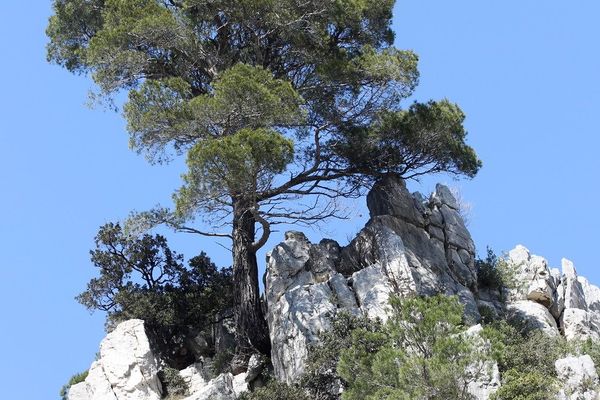
Jerusalem pine
Pinus halepensis
Родина: Pinaceae • Рід: Pinus
БагаторічнаСередньоДекоративна
Bloom Color: Yellow. Main Bloom Time: Early spring, Late spring, Mid spring. Form: Irregular or sprawling, Upright or erect.
Опис
Industrial Crop: Hydrocarbon Management: Standard Regional Crop Landscape Uses:Aggressive surface roots possible, Screen, Specimen. Thrives in a light well-drained sandy or gravelly loam[1, 11]. Dislikes poorly drained moorland soils. Established plants are very tolerant of drought[81, 200], they succeed in poor chalky soils and also in poor dry sandy soils. Fairly wind-resistant. Plants are not very successful in Britain. They are tender when young but are then fully hardy. Plants are strongly outbreeding, self-fertilized seed usually grows poorly. They hybridize freely with other members of this genus. Leaf secretions inhibit the germination of seeds, thereby reducing the amount of pants that can grow under the tree. Plants in this genus are notably susceptible to honey fungus. Special Features: Attractive foliage, Not North American native, Inconspicuous flowers or blooms. Carbon Farming Industrial Crop: Hydrocarbon Materials, chemicals and energy include bioplastics, rubber, biomass products gasoline, jet fuel, diesel, butane, propane, biogas. Plants are usually resprouting plants and saps. Management: Standard Plants grow to their standard height. Harvest fruit, seeds, or other products. Non-Destructive management systems. Regional Crop These crops have been domesticated and cultivated regionally but have not been adopted elsewhere and are typically not traded globally, Examples in this broad category include perennial cottons and many nuts and staple fruits. References Carbon Farming Information and Carbon Sequestration Information Temperature Converter Type a value in the Celsius field to convert the value to Fahrenheit: Celsius Fahrenheit: The PFAF Bookshop Plants For A Future have a number of books available in paperback and digital form. Book titles include Edible Plants , Edible Perennials , Edible Trees , Edible Shrubs , Woodland Gardening , and Temperate Food Forest Plants . Our new book is Food Forest Plants For Hotter Conditions (Tropical and Sub-Tropical) . Shop Now
Походження та ареал
TEMPERATE ASIA: Israel, Jordan, Lebanon, Syria, Turkey EUROPE: Ukraine (Krym), Albania, Bosnia and Herzegovina (west), Greece, Croatia, Italy (incl. Sardinia, Sicily), Montenegro, Spain, France (s. & Corsica) AFRICA: Algeria, Libya, Morocco, Tunisia, South Africa
Корисні властивості
Edible Parts: Edible Uses: Condiment Gum A resin from the trunk is used for chewing and for flavouring wine[177, 200]. A vanillin flavouring is obtained as a by-product of other resins that are released from the pulpwood. References More on Edible Uses
Поради
It is best to sow the seed in individual pots in a cold frame as soon as it is ripe if this is possible otherwise in late winter. A short stratification of 6 weeks at 4°c can improve the germination of stored seed. Plant seedlings out into their permanent positions as soon as possible and protect them for their first winter or two. Plants have a very sparse root system and the sooner they are planted into their permanent positions the better they will grow[K]. Trees should be planted into their permanent positions when they are quite small, between 30 and 90cm. We actually plant them out when they are about 5 - 10cm tall. So long as they are given a very good weed-excluding mulch they establish very well[K]. Larger trees will check badly and hardly put on any growth for several years. This also badly affects root development and wind resistance. Cuttings. This method only works when taken from very young trees less than 10 years old. Use single leaf fascicles with the base of the short shoot. Disbudding the shoots some weeks before taking the cuttings can help. Cuttings are normally slow to grow away.