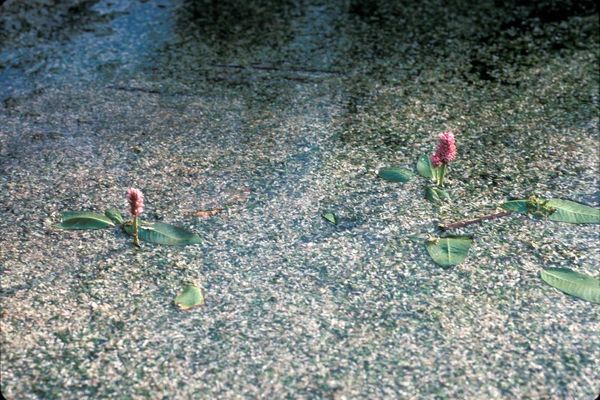
Amphibious bistort
Persicaria amphibia
Родина: Polygonaceae • Рід: Persicaria
БагаторічнаСередньоДекоративна
Опис
A water or marsh plant growing in water up to 3 metres deep or in boggy soil. This species is hardy to about -25°c. Plants seem to be immune to the predations of rabbits. The leaves are often attacked by the larvae of the water-lily beetle. Plants can either be aquatic with floating ovate-oblong leaf-blades or a leggy marsh plant with lanceolate leaves. Their stems root at the nodes wherever they come into contact with the soil. References Carbon Farming Information and Carbon Sequestration Information Temperature Converter Type a value in the Celsius field to convert the value to Fahrenheit: Celsius Fahrenheit: The PFAF Bookshop Plants For A Future have a number of books available in paperback and digital form. Book titles include Edible Plants , Edible Perennials , Edible Trees , Edible Shrubs , Woodland Gardening , and Temperate Food Forest Plants . Our new book is Food Forest Plants For Hotter Conditions (Tropical and Sub-Tropical) . Shop Now
Походження та ареал
TEMPERATE ASIA: Afghanistan, Iran, Lebanon, Syria, Russian Federation-Ciscaucasia (Ciscaucasia), Armenia, Azerbaijan, Georgia, Russian Federation-Western Siberia (Western Siberia), Russian Federation-Eastern Siberia (Eastern Siberia), Russian Federation (Altay), Kazakhstan, Kyrgyzstan, Tajikistan, Turkmenistan, Uzbekistan, Mongolia, Russian Federation-Far East (Far East), China (Anhui Sheng, Gansu Sheng, Guizhou Sheng, Hebei Sheng, Heilongjiang Sheng, Henan Sheng, Hubei Sheng, Hunan Sheng, Jiang
Корисні властивості
Leaves - raw or cooked. The young shoots are eaten in the spring. Seed - cooked. It is rather small and fiddly to utilize. References More on Edible Uses
Поради
Seed - sow spring in a cold frame. Germination is usually free and easy. When they are large enough to handle, prick the seedlings out into individual pots and plant them out in the summer if they have reached sufficient size. If not, overwinter them in a cold frame and plant them out the following spring after the last expected frosts. Division in spring or autumn. Very easy, larger divisions can be planted out direct into their permanent positions. We have found that it is better to pot up the smaller divisions and grow them on in light shade in a cold frame until they are well established before planting them out in late spring or early summer.