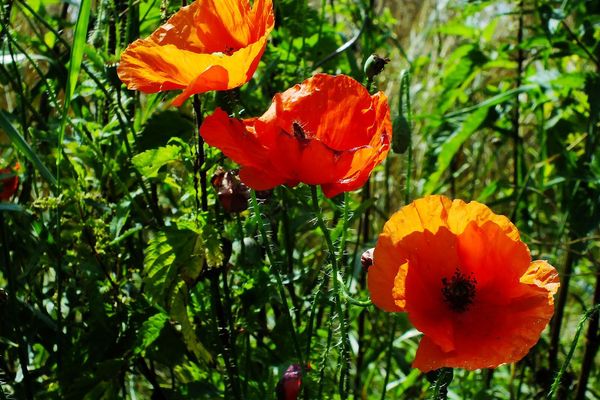
Shirley poppy
Papaver rhoeas
Родина: Papaveraceae • Рід: Papaver
БагаторічнаСередньоДекоративна
Bloom Color: Red. Main Bloom Time: Early summer, Late spring. Form: Upright or erect.
Опис
Landscape Uses:Border, Massing, Seashore, Specimen. Prefers a well-drained sandy loam in a sunny position[1, 200]. Does not do well on wet clay soils but succeeds in most other soils. Plants usually self-sow freely when growing in suitable conditions so long as the soil surface is disturbed. There are several named varieties selected for their ornamental value. A polymorphic species, varying in leaf shape and flower colour. When growing in cereal fields, poppies decrease the yields of nearby cereal plants[18, 20]. Members of this genus are rarely if ever troubled by browsing deer or rabbits. Special Features: Attractive foliage, Not North American native, Naturalizing, All or parts of this plant are poisonous, Suitable for cut flowers, Suitable for dried flowers. References Carbon Farming Information and Carbon Sequestration Information Temperature Converter Type a value in the Celsius field to convert the value to Fahrenheit: Celsius Fahrenheit: The PFAF Bookshop Plants For A Future have a number of books available in paperback and digital form. Book titles include Edible Plants , Edible Perennials , Edible Trees , Edible Shrubs , Woodland Gardening , and Temperate Food Forest Plants . Our new book is Food Forest Plants For Hotter Conditions (Tropical and Sub-Tropical) . Shop Now
Походження та ареал
TEMPERATE ASIA: Afghanistan, Cyprus, Egypt (Sinai), Iran, Iraq, Israel, Jordan, Lebanon, Syria, Turkey, Russian Federation-Ciscaucasia (Ciscaucasia), Armenia, Azerbaijan, Georgia, Russian Federation (Dagestan) TROPICAL ASIA: Pakistan EUROPE: Denmark, United Kingdom, Ireland, Norway (southeast), Sweden (south), Austria, Belgium, Switzerland, Czech Republic, Germany, Hungary, Netherlands, Poland, Slovakia, Russian Federation-European part (European part (west)), Belarus, Lithuania, Latvia, Moldova
Корисні властивості
Edible Parts: Flowers Leaves Oil Seed Edible Uses: Colouring Oil Seed - raw or cooked. Much used as a flavouring in cakes, bread, fruit salads etc[4, 5, 21, 183], it imparts a very nice nutty flavour[K]. The seeds are rather small, but they are contained in fairly large seed pods and so are easy to harvest. The seeds are perfectly safe to eat, containing none of the alkaloids associated with other parts of the plant. Leaves - raw or cooked[7, 52]. Used like spinach or as a flavouring in soups and salads[132, 183]. The leaves should not be used after the flower buds have formed. Some caution is advised, see the notes above on toxicity. An edible oil is obtained from the seed[2, 4]. Said to be an excellent substitute for olive oil[4, 183], it can be used in salad dressings or for cooking. A syrup can be prepared from the scarlet flower petals, it is used in soups, gruels etc[4, 183]. A red dye from the petals is used as a food flavouring, especially in wine. References More on Edible Uses
Поради
Seed - sow spring or autumn in situ.