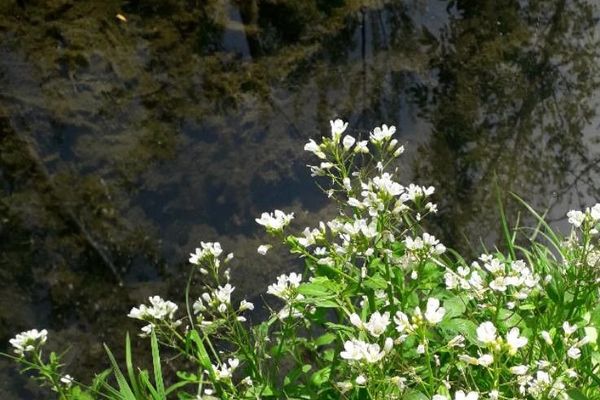
Опис
Landscape Uses:Container. Watercress is easily grown when given the correct conditions of slowly flowing clean water, preferably coming from chalky or limestone soils. It prefers to grow in water about 5cm deep with an optimum pH 7.2. Plants can be grown in wet soil if the position is somewhat shaded and protection is given in winter, though the flavour may be hotter[27, 37]. Hardy to about -15°c. Watercress is often cultivated for its edible leaves, there are some named varieties[16, 183]. The plant is very sensitive to pollution so a clean source of water is required. Plants will often continue to grow all through mild winters. A fast-growing plant, the stems trail along the ground or float in water and produce new roots at the leaf nodes, thus making the plant very easy to propagate vegetatively. Unfortunately, virus diseases have become more common in cultivated plants and so most propagation is carried out by seed. This is a diploid species. It has hybridised naturally in the wild with the triploid species N. microphyllum to produce the sterile hybrid N. x sterilis which is also commonly cultivated as a salad crop. The flowers are a rich source of pollen and so are very attractive to bees. Special Features: Attractive foliage, Edible, Not North American native, Wetlands plant, Flower characteristics are unknown. For polyculture design as well as the above-ground architecture (form - tree, shrub etc. and size shown above) information on the habit and root pattern is also useful and given here if available. The plant growth habit is a runner spreading indefinitely by rhizomes or stolons [1-2]. The root pattern is fibrous dividing into a large number of fine roots [1-2]. Watercress grows rapidly, often establishing itself in a few weeks under ideal conditions. The leaves can be harvested year-round, but spring to early autumn is the best time. Watercress typically flowers in late spring to summer. Watercress is self-fertile. References Carbon Farming Information and Carbon Sequestration Information Temperature Converter Type a value in the Celsius field to convert the value to Fahrenheit: Celsius Fahrenheit: The PFAF Bookshop Plants For A Future have a number of books available in paperback and digital form. Book titles include Edible Plants , Edible Perennials , Edible Trees , Edible Shrubs , Woodland Gardening , and Temperate Food Forest Plants . Our new book is Food Forest Plants For Hotter Conditions (Tropical and Sub-Tropical) . Shop Now
Походження та ареал
TEMPERATE ASIA: Armenia, Azerbaijan, Ciscaucasia, Cyprus, Dagestan, Egypt, Georgia, Iran, Iraq, Israel, Jordan, Kazakhstan, Kyrgyzstan, Lebanon, Russian Federation, Russian Federation-Ciscaucasia, Sinai, Syria, Tajikistan, Turkey, Turkmenistan, Uzbekistan,Afghanistan. TROPICAL ASIA: India, Pakistan, EUROPE: Denmark, United Kingdom (U.K.), Ireland, Sweden (south), Austria, Belgium, Switzerland, Czech Republic, Germany, Hungary, Netherlands, Poland, Slovakia, Ukraine (incl. Krym), Albania, Bulgari
Корисні властивості
Edible Parts: Leaves Seed Edible Uses: Condiment Leaves - raw or cooked[2, 5, 7, 9, 16, 27]. Water cress is mainly used as a garnish or as an addition to salads, the flavour is strong with a characteristic hotness. It has a reputation as a spring tonic, and this is its main season of use, though it can be harvested for most of the year and can give 10 pickings annually. Some caution is advised if gathering the plant from the wild, see the notes above on toxicity. The leaves are exceptionally rich in vitamins and minerals, especially iron. A nutritional analysis is available. The seed can be sprouted and eaten in salads. A hot mustardy flavour[K]. The seed is ground into a powder and used as a mustard[46, 183]. The pungency of mustard develops when cold water is added to the ground-up seed - an enzyme (myrosin) acts on a glycoside (sinigrin) to produce a sulphur compound. The reaction takes 10 - 15 minutes. Mixing with hot water or vinegar, or adding salt, inhibits the enzyme and produces a mild but bitter mustard. References More on Edible Uses Composition Figures in grams (g) or miligrams (mg) per 100g of food. Leaves (Fresh weight) 19 Calories per 100g Water : 93.3% Protein: 2.2g; Fat: 0.3g; Carbohydrate: 3g; Fibre: 0.7g; Ash: 1.2g; Minerals - Calcium: 151mg; Phosphorus: 54mg; Iron: 1.7mg; Magnesium: 0mg; Sodium: 52mg; Potassium: 282mg; Zinc: 0mg; Vitamins - A: 2940mg; Thiamine (B1): 0.08mg; Riboflavin (B2): 0.16mg; Niacin: 0.9mg; B6: 0mg; C: 79mg; Reference: [ 218] Notes:
Поради
Seed - sow spring in a pot emmersed to half its depth in water. Germination should take place within a couple of weeks. Prick out seedlings into individual pots whilst they are still small and increase the depth of water gradually until they are submerged. Plant out into a pond in the summer. Cuttings can be taken at any time in the growing season. Virtually any part of the plant, including a single leaf, will form roots if detached from the parent plant. Just put it in a container of water until the roots are well formed and then plant out in shallow water.