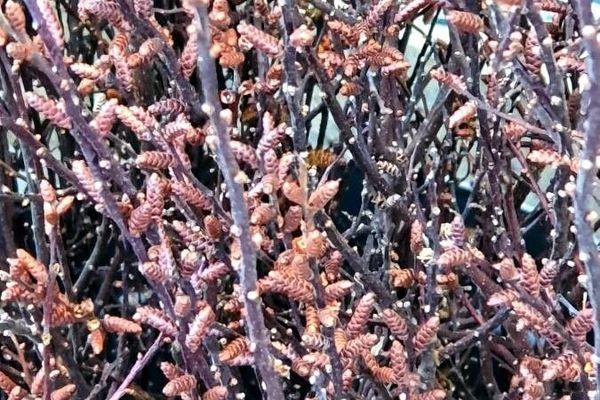
Bog-myrtle
Myrica gale
Родина: Myricaceae • Рід: Myrica
БагаторічнаСередньоДекоративна
Опис
There is some difference of opinion about the needs of this plant. Most reports say that it prefers a moist soil and that it grows well in an open position in a well-drained soil in sun or light shade. Most reports also say that it prefers or even requires a lime-free loamy or peaty soil[1, 200] but another report says that it succeeds in any ordinary garden soil. In the wild it is usually found in soils with a pH between 3.5 and 6, but it is also sometimes found in fens with a pH as high as 7.5. A suckering shrub, when well sited it can form thickets. This species has a symbiotic relationship with certain soil micro-organisms, these form nodules on the roots of the plants and fix atmospheric nitrogen. Some of this nitrogen is utilized by the growing plant but some can also be used by other plants growing nearby.This habit also allows the plant to succeed in water-logged soils. Dioecious. Male and female plants must be grown if seed is required. This plant is occasionally monoecious and also can change sex from year to year. Flowers are produced mainly on one-year old wood. All parts of the plant are pleasantly aromatic. A good food plant for the caterpillars of many species of butterflies. Plants in this genus are notably resistant to honey fungus. The plant is heat tolerant in zones 6 through 1. (Plant Hardiness Zones show how well plants withstand cold winter temperatures. Plant Heat Zones show when plants would start suffering from the heat. The Plant Heat Zone map is based on the number of "heat days" experienced in a given area where the temperature climbs to over 86 degrees F (30°C). At this temperature, many plants begin to suffer physiological damage. Heat Zones range from 1 (no heat days) to 12 (210 or more heat days). For example Heat Zone. 11-1 indicates that the plant is heat tolerant in zones 11 through 1.) For polyculture design as well as the above-ground architecture (form - tree, shrub etc. and size shown above) information on the habit and root pattern is also useful and given here if available. The plant growth habit is multistemmed with multiple stems from the crown [1-2]. The root pattern is stoloniferous rooting from creeping stems above the ground [1-2]. References Carbon Farming Information and Carbon Sequestration Information Temperature Converter Type a value in the Celsius field to convert the value to Fahrenheit: Celsius Fahrenheit: The PFAF Bookshop Plants For A Future have a number of books available in paperback and digital form. Book titles include Edible Plants , Edible Perennials , Edible Trees , Edible Shrubs , Woodland Gardening , and Temperate Food Forest Plants . Our new book is Food Forest Plants For Hotter Conditions (Tropical and Sub-Tropical) . Shop Now
Походження та ареал
TEMPERATE ASIA: Habarovskij kraj, Hokkaidô, Honshu (east), Japan, Kamcatskij kraj, Korea, North, Primorye, Sakhalin,Russian Federation. NORTHERN AMERICA: Canada, Northwest Territories (south), Yukon, Québec, Nova Scotia, Ontario, Prince Edward Island, New Brunswick, Newfoundland and Labrador, Saskatchewan, Alberta, Manitoba, British Columbia, United States, Alaska, Connecticut, Maine, Massachusetts, Michigan, New Hampshire, New Jersey (north), New York, Ohio (Seneca Co. (extirpated?)), Pennsylva
Корисні властивості
Edible Parts: Fruit Edible Uses: Condiment Tea The aromatic fruits and leaves are used either fresh or dried to flavour soups, stews etc[2, 4, 62, 100, 183]. They are sometimes put in beer and ale to improve the flavour and increase foaming. The fruit is about 3mm in diameter with a single large seed. The dried leaves make a delicate and palatable tea[4, 62, 172, 183]. References More on Edible Uses
Поради
Seed - best sown as soon as it is ripe in the autumn in a cold frame. Barely cover the seed and keep it moist. Stored seed germinates more freely if given a 3 month cold stratification and then sown in a cold frame. Germination is usually good. Prick out the seedlings into individual pots when they are large enough to handle and grow on in the cold frame for the first winter. Plant out in late spring or early summer[K]. Cuttings of half-ripe wood, 5 - 8cm with a heel, July/August in a frame. Pot up and overwinter in a cold frame. Fair to good percentage. Cuttings of mature wood in November/December in a frame. Layering in spring. Division of suckers in the dormant season. Plant them out direct into their permanent positions.