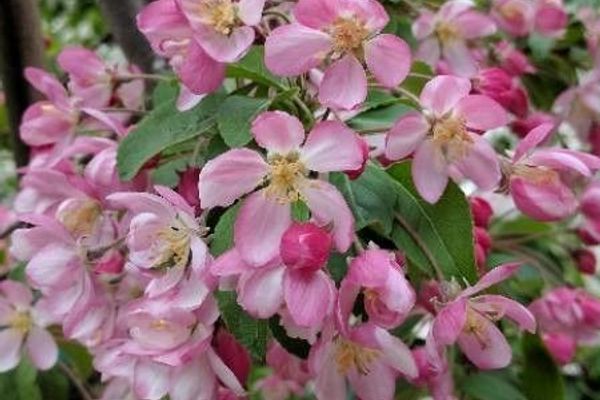
Apple
Malus domestica
Родина: Rosaceae • Рід: Malus
БагаторічнаСередньоДекоративна
Malus species Apples are small to medium-sized deciduous trees, typically growing from 4–12m (14–40ft) tall, with edible fruit produced in autumn. Orchard Apples (M. domestica) are cultivated for their edible fruit and grafted onto rootstocks to control their size and disease resistance. They are a hybrid of mixed origins, including M. dasyphylla, M. praecox, M. pumila, M. sieversii and M. sylvestris. There are many named varieties with different flavours ranging from sour to sweet and textures
Опис
An easily grown plant, it succeeds in most fertile soils, preferring a moisture retentive well-drained loamy soil[1, 200]. Grows well in heavy clay soils, though if these are poorly drained there could be problems with diseases such as canker. Prefers a sunny position but succeeds in partial shade though it fruits less well in such a situation[1, 200]. Tolerates a pH range from 6 to 7, preferring a range of 6.5 to 6.8. The apple is one of the most commonly cultivated fruit crops in the temperate zone. The primary climatic requirements for the production of good quality fruit are warm summer temperatures, relative freedom from spring frosts, reasonable protection from the wind (especially cold north and east winds) and an evenly distributed rainfall of about 600 - 800mm per annum. Good apple production has been achieved as far north as 65°, whilst about 1000 hours of winter temperatures below 7°c are necessary to initiate flower production. However good quality apples can still be produced in other areas with careful management and choice of cultivars. Even in tropical latitudes, the plant has succeeded at high elevations, producing fruit at elevations over 3000 metres in Ecuador for example. Where space is at a premium, or at the limits of their climatic range, apples can be grown against a wall. Most cultivars will grow well against a sunny south or west facing wall, an east facing wall will suit many of the tougher cultivars and even a north facing wall can be used for early culinary cultivars. A hybrid of mixed origins, including M. dasyphylla, M. praecox, M. pumila, M. sieversii and M. sylvestris, this species is very commonly cultivated in temperate areas for its edible fruit. There are very many named varieties[46, 183, 200] and with careful choice of these varieties it is possible to provide freshly harvested fruit from July to December and stored fruit for the rest of the year. When chives (Allium schoenoprasum) or other alliums are grown under apple trees it can prevent or cure scab. A spray of the infused leaves of Equisetum spp can also be used against scab[18, 201]. If climbing nasturtiums (Tropaeolum majus) are grown into the tree they can repel woolly aphis[18, 201]. Apples lose their flavour if they are stored with potatoes. They will also impart a bitter flavour to carrots or potatoes if they are stored in the same area. Growing apples near potatoes makes the potatoes more susceptible to blight. Wrapping maple leaves (Acer spp) around apples in store helps to preserve the apples[18, 20]. Apples store better if they are grown in a sward that contains a high percentage of clover. Apple trees grow better and produce better quality fruit when foxgloves (Digitalis spp) and wallflowers (Erysimum cheiri) are growing in the orchard. Dandelions (Taraxacum spp) produce ethylene gas and this can cause earlier ripening of fruit if plants are growing in an orchard. The fruit is a good wildlife food source, especially for birds. Hybridizes freely with other members of this genus. Plants in this genus are notably susceptible to honey fungus. Some Malus species are self-fertile, while others may require cross-pollination with another variety for a better fruit set. Apples generally have a moderate growth rate, often reaching maturity in 3 to 5 years, depending on the variety and growing conditions. References Carbon Farming Information and Carbon Sequestration Information Temperature Converter Type a value in the Celsius field to convert the value to Fahrenheit: Celsius Fahrenheit: The PFAF Bookshop Plants For A Future have a number of books available in paperback and digital form. Book titles include Edible Plants , Edible Perennials , Edible Trees , Edible Shrubs , Woodland Gardening , and Temperate Food Forest Plants . Our new book is Food Forest Plants For Hotter Conditions (Tropical and Sub-Tropical) . Shop Now
Походження та ареал
Afghanistan, Kazakhstan, Kirgizstan, Pakistan, Tadzhikistan, Uzbekistan, Xinjiang.
Корисні властивості
Edible Parts: Fruit Oil Oil Edible Uses: Oil Oil Pectin Fruit - raw, cooked or dried for later use. Apples are one of the most common and widely grown fruits of the temperate zone. There are a great many named varieties with differing flavours ranging from sour to sweet and textures from dry and mealy to crisp and juicy. There is also a wide range in the seasons of ripening with the first fruits being ready in late July whilst other cultivars are not picked until late autumn and will store for 12 months or sometimes more. See individual records for more details. The fruit of some cultivars is rich in pectin and can be used in helping other fruits to set when making jam etc[61, 142]. Pectin is also said to protect the body against radiation. An edible oil can be obtained from the seed. It would only really be viable to use these seeds as an oil source if the fruit was being used for some purpose such as making cider and then the seeds could be extracted from the remaining pulp[K]. References More on Edible Uses
Поради
Seed - this species is a hybrid and will not breed true from seed, though some interesting new fruiting cultivars can be produced.. It is best sown as soon as it is ripe in the autumn in a cold frame. It usually germinates in late winter. Stored seed requires stratification for 3 months at 1°c and should be sown in a cold frame as soon as it is received. It might not germinate for 12 months or more. Prick out the seedlings into individual pots as soon as they are large enough to handle. If given a rich compost they usually grow away quickly and can be large enough to plant out in late summer, though consider giving them some protection from the cold in their first winter. Otherwise, keep them in pots in a cold frame and plant them out in late spring of the following year. Cuttings of mature wood, November in a frame.