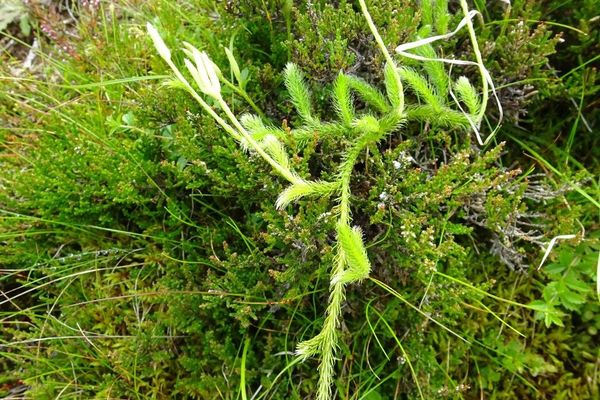
Ground-pine
Lycopodium clavatum
Родина: Lycopodiaceae • Рід: Lycopodium
БагаторічнаСередньоДекоративна
Опис
A plant with a very wide range, found at sea level in the Arctic circle to highland areas above 1,300 metres in the tropics. It is hardy to at least -15°c[238 ]. Thrives in a rough spongy peat in a shady position[1 ]. Requires a humid atmosphere[200 ]. Lycopodium clavatum is very variable, and there is a nearly continuous series of forms from compact plants with parallel branches and firm, imbricate leaves to amply branched plants with diverging branches and soft, spreading leaves. The former is typical for cold and exposed habitats, the latter for warm and sheltered locations[299 ]. Terrestrial members of this genus are hard to establish. The roots are delicate and liable to rot, most water is absorbed through the foliage[200 ]. The subterranean prothallus develops slowly and reaches sexual maturity after 6 - 15 years and may live for 20 years[299 ]. It is top-shaped, differentiated into various tissues and lives in close symbiosis with a fungus, possibly a species of Pythium. Without the fungus, the development of the gametophyte stops at an early, few-celled stage. Once the sporophyte has established, it can spread rapidly by the long creeping stems[299 ]. If competition with higher growing plants is not strong, it is long-lived and slowly forms large colonies[299 ]. The spores are used as a reference in pollen traps used to monitor pollen in the air to establish hay-fever risks[299 ]. Members of this genus are rarely if ever troubled by browsing deer[233 ]. Although looking more like a moss, this genus is closely related to the ferns[200 ]. References Carbon Farming Information and Carbon Sequestration Information Temperature Converter Type a value in the Celsius field to convert the value to Fahrenheit: Celsius Fahrenheit: The PFAF Bookshop Plants For A Future have a number of books available in paperback and digital form. Book titles include Edible Plants , Edible Perennials , Edible Trees , Edible Shrubs , Woodland Gardening , and Temperate Food Forest Plants . Our new book is Food Forest Plants For Hotter Conditions (Tropical and Sub-Tropical) . Shop Now
Походження та ареал
TEMPERATE ASIA: Amur, Buryatia, China, Chita, Cukotskij avtonomnyj okrug, Gorno-Altay, Habarovskij kraj, Hokkaidô, Honshu, Irkutsk, Japan, Jilin Sheng, Kamcatskij kraj, Krasnoyarsk, Kyushu, Magadanskaja oblast, Primorye, Respublika, Russian Federation, Russian Federation, Sakhalin, Shikoku, Taiwan, Tyumen, Tyva, Yakutia-Sakha, Yunnan Sheng,Georgia. TROPICAL ASIA: Thailand, Vietnam, NORTHERN AMERICA: Canada, Northwest Territories, Yukon, Québec, Nova Scotia, Ontario, Prince Edward Island, New Bru
Корисні властивості
None known References More on Edible Uses
Поради
Spores - best sown as soon as they are ripe on the surface of a humus-rich sterilized soil. Keep the compost moist, preferably by putting a plastic bag over the pot. Pot on small clumps of plantlets as soon as they are large enough to handle and keep humid until they are well established. Do not plant outside until the ferns are at least 2 years old and then only in a very well sheltered position. The spores are generally produced in abundance but are difficult to grow successfully. Layering of growing tips.