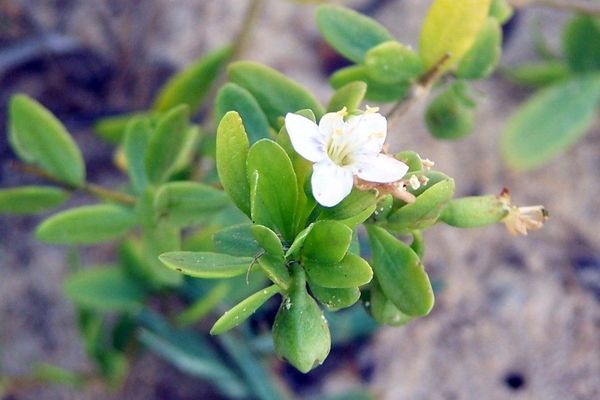
African boxthorn
Lycium ferocissimum
Родина: Solanaceae • Рід: Lycium
БагаторічнаСередньоДекоративна
Boxthorns have adapted to hot, dry conditions and drought tolerance and are often found in dry, desert-like environments. African Boxthorn (L. ferocissimum) berries, leaves, stems and roots are toxic to humans. They are highly resilient to heat and drought and are used as hedges or ornamental plants. It is invasive in some regions. The genus name Lycium derives from the Greek name lykion, meaning thorny shrub. The species name ferocissimum comes from the Latin ferox, meaning wild, bold, or fierc
Опис
Soil Tolerances: Light (sands, sandy loams), Medium (loams, sandy clay loams). Acid (pH 4.0-6.0). Neutral (pH 6.1-7.4). Free Soil drainage. Special soil tolerances: Infertile, Saline. Soil Types: Alkaline Soils, Alluvial Soils, Arenosols, Arid Soils, Cambisols, Clay Soils, Luvisols, Podzols, Regosols, Saline Soils, Sandy Soils, Volcanic Soils [1-8]. A woody, erect, perennial shrub with a deep and extensive root system (Roy et al., 1998). It can grow up to 5 m tall and 5 m wide but typically grows only 2-3 m tall and 3 m wide. It is particularly common on roadsides, railway embankments, watercourses, wastelands, and similar neglected areas. Large thickets reduce the productive value of grazing land and can harbour agricultural pests such as rabbits. The native range of this species is S. Africa. It is a shrub and grows primarily in the subtropical biome. It has been introduced into Algeria, California, Cyprus, Morocco, New South Wales, New Zealand North, Norfolk Is., Northern Territory, Queensland, South Australia, Spain, Tasmania, Tunisia, Victoria, and Western Australia [2-5]. Soil Texture: Thrives in light (sandy), medium, and heavy (clay) soils. Adaptable to poor, rocky, or degraded soils. Soil Moisture: Prefers dry to moderately moist soils. It is drought-tolerant once established and does not tolerate prolonged waterlogging. Drainage: Requires well-drained soil but can survive in various soil types without prolonged waterlogging. Soil pH: Tolerates a wide range of soil pH levels, from acidic to alkaline. Saline Tolerance: Highly tolerant of saline conditions, making it suitable for coastal areas and salt-affected soils. Tolerance of Poor Soil: It thrives in poor, nutrient-deficient soils and is often found in disturbed or marginal habitats. Light Requirements: Requires full sun for optimal growth. It tolerates light shade but may grow less vigorously. Height: Typically grows to about 2–5 meters (6–16 feet) tall, forming a dense, spiny shrub. Pollination: Pollinated by bees, birds, and other insects that visit its small, tubular white to purple flowers. Temperature: Hardy to drought and frost, thriving in USDA zones 8–11. It is well-adapted to arid and semi-arid climates. Wildlife: Provides excellent habitat and protection for birds and small mammals due to its dense, thorny branches. Invasiveness: Known to be an invasive species in some areas, such as Australia, where it can form dense thickets that displace native vegetation. Pests and Diseases: Generally pest-resistant. However, it may act as a host for some pests like fruit flies, which can affect nearby crops. Pruning: Regular pruning is necessary to control its spread and manage its thorny growth. Caution: In areas where it is invasive, management may be required to prevent its spread. It can outcompete native vegetation and form dense thickets that are difficult to remove. References Carbon Farming Information and Carbon Sequestration Information Temperature Converter Type a value in the Celsius field to convert the value to Fahrenheit: Celsius Fahrenheit: The PFAF Bookshop Plants For A Future have a number of books available in paperback and digital form. Book titles include Edible Plants , Edible Perennials , Edible Trees , Edible Shrubs , Woodland Gardening , and Temperate Food Forest Plants . Our new book is Food Forest Plants For Hotter Conditions (Tropical and Sub-Tropical) . Shop Now
Походження та ареал
Native to: Cape Provinces, Free State, Lesotho.
Корисні властивості
Fruit berries are NOT edible and are approximately 10 mm in diameter with a persistent calyx. They are initially green but ripen to bright orange or red. Berries are mostly globular but sometimes can be slightly ovoid. References More on Edible Uses
Поради
Propagates easily from seeds dispersed by birds and animals that eat the fruit. Can also grow from cuttings.