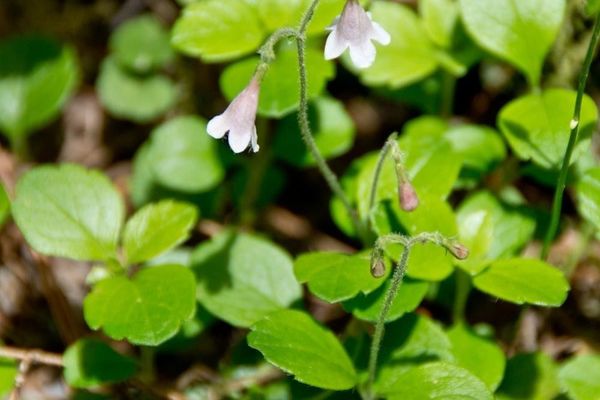
Twinflower
Linnaea borealis
Родина: Caprifoliaceae • Рід: Linnaea
БагаторічнаСередньоДекоративна
Bloom Color: Pink. Main Bloom Time: Early summer, Late summer, Mid summer. Form: Prostrate, Spreading or horizontal.
Опис
Landscape Uses:Ground cover, Rock garden, Woodland garden. Prefers a rather shaded position in a rock garden in a moist peaty soil[11, 200]. It grows well in pine woods. Requires an acid soil. Plants can be rather difficult to establish. The sub-species L. borealis americana grows more freely than the European form. The plant is polymorphic. The flowers have an evening fragrance like that of the honeysuckle. Special Features:North American native, Fragrant flowers. The plant is heat tolerant in zones 9 through 6. (Plant Hardiness Zones show how well plants withstand cold winter temperatures. Plant Heat Zones show when plants would start suffering from the heat. The Plant Heat Zone map is based on the number of "heat days" experienced in a given area where the temperature climbs to over 86 degrees F (30°C). At this temperature, many plants begin to suffer physiological damage. Heat Zones range from 1 (no heat days) to 12 (210 or more heat days). For example Heat Zone. 11-1 indicates that the plant is heat tolerant in zones 11 through 1.) For polyculture design as well as the above-ground architecture (form - tree, shrub etc. and size shown above) information on the habit and root pattern is also useful and given here if available. An evergreen. A clumping mat former. Forming a dense prostrate carpet spreading indefinitely [1-2]. The root pattern is fibrous dividing into a large number of fine roots [1-2]. The root pattern is suckering with new plants from underground runners away from the plant [1-2]. References Carbon Farming Information and Carbon Sequestration Information Temperature Converter Type a value in the Celsius field to convert the value to Fahrenheit: Celsius Fahrenheit: The PFAF Bookshop Plants For A Future have a number of books available in paperback and digital form. Book titles include Edible Plants , Edible Perennials , Edible Trees , Edible Shrubs , Woodland Gardening , and Temperate Food Forest Plants . Our new book is Food Forest Plants For Hotter Conditions (Tropical and Sub-Tropical) . Shop Now
Походження та ареал
TEMPERATE ASIA: Georgia. NORTHERN AMERICA: Canada, Northwest Territories, Yukon, Québec, Nova Scotia, Ontario, Prince Edward Island, New Brunswick, Newfoundland and Labrador, Saskatchewan, Alberta, Manitoba, British Columbia, Nunavut, United States, Alaska, Connecticut, Indiana, Maine, Massachusetts, New Hampshire, New York, Rhode Island, West Virginia, Minnesota, North Dakota, South Dakota, Arkansas, New Mexico, Arizona, California, EUROPE: Denmark, Finland, United Kingdom (U.K.), Norway, Austr
Корисні властивості
Edible Parts: Leaves Edible Uses: A food plant[177, 257]. No more details are given. References More on Edible Uses
Поради
Seed - best sown as soon as it is ripe in the autumn in a cold frame. Sow stored seed as soon as possible, it is likely to require a period of cold stratification. When they are large enough to handle, prick the seedlings out into individual pots and grow them on in the greenhouse for their first winter. Plant them out into their permanent positions in late spring or early summer, after the last expected frosts. Division of rooted runners in the spring. Layering. Cuttings of half-ripe wood in the summer. They are rather slow to root.