Опис
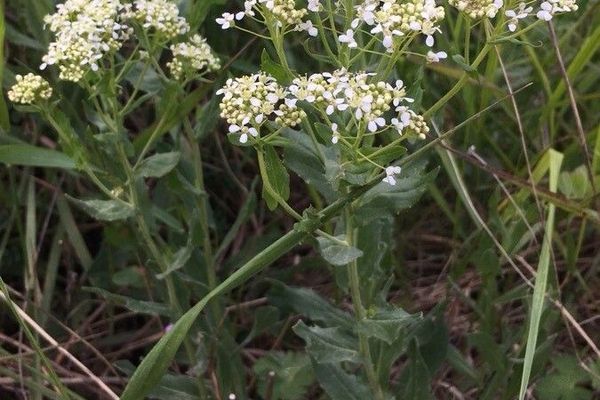
Growing Conditions: Heartpod hoarycress thrives in disturbed soils, rangelands, roadsides, agricultural fields, open pastures, canal banks, and overgrazed lands. It tolerates both clay and sandy soils and is remarkably drought-resistant once established due to its deep and extensive rhizome system. Full sun promotes dense flowering, though plants tolerate partial shade. It is a hardy perennial, typically suited to USDA Hardiness Zones 3–9. Moisture increases biomass, but dryness does not deter survival. Habitat & Range: Native to Eurasia, heartpod hoarycress is now abundant throughout western and central North America. It occurs from lowland valleys to mid-elevation foothills and spreads aggressively along disturbed corridors. In the Southwest, it is common in Colorado, Utah, Nevada, Arizona, and New Mexico, extending northward across the Rockies and westward into California and the Great Basin. Its spread is rapid and ecologically disruptive, often dominating entire fields. Size & Landscape Performance Plants typically grow 15–50 cm tall, depending on soil fertility and moisture. Colonies may cover entire patches of ground, forming near-monocultures. Its extensive rhizomes enable it to re-sprout after cutting, grazing, or shallow tilling, making it tenacious but also reliable for harvest. Cultivation (Horticulture): Cultivation is strongly discouraged due to its invasive nature. However, to understand its growth: it thrives with minimal care, spreads vigorously by rhizomes and seeds, and survives drought, frost, and heavy disturbance. If managed intentionally, it would require strict containment. Because edible parts are abundant in the wild, cultivation is unnecessary. Identification & Habit: Heartpod hoarycress is a perennial mustard forming dense colonies through an extensive rhizome network. Plants range from 15–50 cm tall, producing upright stems clothed in alternating, grayish, pubescent leaves that lend the plant a hoary or weathered appearance. Lower leaves are oblanceolate to elliptic with obscure teeth, while upper leaves clasp the stems—one of its most distinctive vegetative traits. Inflorescences are dense racemes of small, snow-white, four-petalled flowers that collectively resemble masses of white foam or low, drifting clouds. Mature plants produce plump, hairless, heart-shaped pods—another key diagnostic feature. Overall, the habit is colonial, upright, and visually conspicuous during bloom. References Carbon Farming Information and Carbon Sequestration Information Temperature Converter Type a value in the Celsius field to convert the value to Fahrenheit: Celsius Fahrenheit: The PFAF Bookshop Plants For A Future have a number of books available in paperback and digital form. Book titles include Edible Plants , Edible Perennials , Edible Trees , Edible Shrubs , Woodland Gardening , and Temperate Food Forest Plants . Our new book is Food Forest Plants For Hotter Conditions (Tropical and Sub-Tropical) . Shop Now
Походження та ареал
TEMPERATE ASIA: Cyprus, Egypt (Sinai), Iraq, Israel, Jordan, Lebanon, Syria, Turkey, Russian Federation-Ciscaucasia (Ciscaucasia), Armenia, Azerbaijan, Georgia, Russian Federation (Dagestan), Russian Federation (Altay, Irkutsk, Kurganskaja oblast, Omsk), Kazakhstan, Turkmenistan, Uzbekistan, China (Liaoning Sheng, Shandong Sheng, Xinjiang Uygur Zizhiqu) TROPICAL ASIA: Pakistan EUROPE: Austria, Russian Federation (European part), Moldova, Ukraine (incl. Krym), Albania, Bulgaria, Bosnia and Herzeg
Корисні властивості
Young leaves and shoots - raw in salads or cooked as a potherb[2, 61, 105, 183]. A report says that the young leaves contain the toxin hydrogen cyanide, though does not give any more details. In small quantities this substance is fairly harmless, and has even been recommended as having health benefits, but caution is suggested if you eat these leaves[K]. The pungent leaves are used as a seasoning. The seed is used as a condiment, it is a pepper substitute[2, 17, 61, 74, 148, 183]. Edible Uses & Rating: The leaves, flowers, and seeds are edible cooked. Raw flavours are intensely spicy, mustardy, and sharp—far too aggressive for salads—while the hoary texture of the leaves is off-putting. Cooking dramatically improves all edible parts, softening fibres, neutralizing bitterness, and reducing glucosinolate pungency. Flowers are somewhat milder and can be used similarly to broccoli florets when briefly cooked, although their flavour is nowhere near as refined. Seeds are spicy and benefit from toasting or boiling to improve palatability. Due to the plant’s abundance and reliability, it rates highly as a survival or bulk-foraging species, even though its culinary quality is moderate [2-3]. Edibility rating: 3/5 for flavour; 5/5 for abundance. Taste, Processing & Kitchen Notes: Fresh leaves taste spicy, acrid, and cabbage-like with a strong “wild mustard” intensity. Felt-like hairs may create a dry, hoary mouthfeel, but these soften with heat. Boiled leaves become mild and palatable. Fresh flowers are slightly sweet due to nectar traces and are the mildest raw component. Unopened flower clusters resemble miniature broccoli and can be cooked similarly—steamed, boiled, or incorporated into mixed greens. Seeds are hot and mustard-like; roasting brings out nutty notes and reduces harshness. Because hoarycress often grows in disturbed or agricultural soils, thorough washing is essential. Cooking is strongly recommended regardless of part used. Seasonality (Phenology): Rosettes emerge in early spring, and flowering begins from May through August depending on climate and elevation. Flower clusters remain showy for weeks, followed by rapid seedpod maturation. Seeds persist into summer, though they drop easily when tapped, facilitating both harvest and natural spread. Leaves become tougher and less palatable as plants mature, so the ideal harvest window is spring through early summer [2-3]. Safety & Cautions (Food Use): Raw plant material can be harsh, spicy, and irritating. Cooking is essential for neutralizing potentially harmful glucosinolates. Although livestock toxicity is documented, properly cooked human portions are considered safe. Avoid harvesting from contaminated roadsides or areas treated with herbicides, as hoarycress is frequently targeted for control. Look-Alikes & Confusion Risks: Heartpod hoarycress resembles other Cardaria species, but those produce round instead of heart-shaped pods and may have hairy sepals. It may also be confused with some
Поради
Seed - sow in situ in spring. There is very little need to encourage this plant, it is a rapidly spreading weed in Britain. Division in spring.