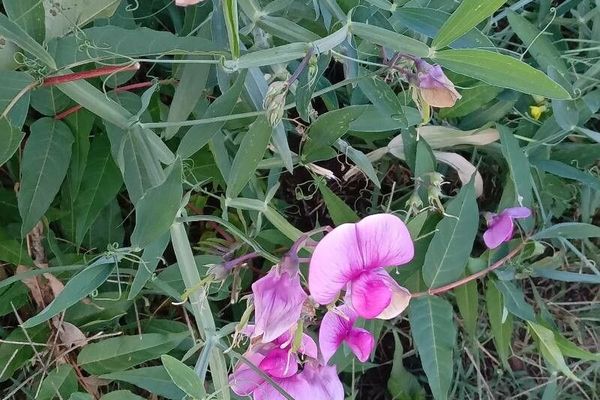
Everlasting-pea
Lathyrus latifolius
Родина: Fabaceae • Рід: Lathyrus
БагаторічнаСередньоДекоративна
Bloom Color: Pink, Red, White. Main Bloom Time: Early summer, Late summer, Mid summer. Form: Spreading or horizontal.
Опис
Landscape Uses:Arbor, Container. An easily grown plant, succeeding in any moderately good garden soil, whether acid or alkaline. Prefers a position in full sun but tolerates part day shade. Succeeds in dry soils and is drought tolerant when established. Grows well on dry slopes. Plants can be grown in quite coarse grass, which can be cut annually in the autumn. Plants are hardy to at least -10°c. A very ornamental plant, there are many named varieties. It is fast-growing and, when in a suitable position, can become invasive. Plants climb by means of tendrils. Resents root disturbance and can take a year or two to settle down after being moved. This species has a symbiotic relationship with certain soil bacteria, these bacteria form nodules on the roots and fix atmospheric nitrogen. Some of this nitrogen is utilized by the growing plant but some can also be used by other plants growing nearby. Special Features:All or parts of this plant are poisonous, Suitable for cut flowers. The plant is heat tolerant in zones 9 through 5. (Plant Hardiness Zones show how well plants withstand cold winter temperatures. Plant Heat Zones show when plants would start suffering from the heat. The Plant Heat Zone map is based on the number of "heat days" experienced in a given area where the temperature climbs to over 86 degrees F (30°C). At this temperature, many plants begin to suffer physiological damage. Heat Zones range from 1 (no heat days) to 12 (210 or more heat days). For example Heat Zone. 11-1 indicates that the plant is heat tolerant in zones 11 through 1.) For polyculture design as well as the above-ground architecture (form - tree, shrub etc. and size shown above) information on the habit and root pattern is also useful and given here if available. Herbaceous. A suckering vine sending up suckers some distance main plant [1-2]. The root pattern is rhizomatous with underground stems sending roots and shoots along their length [1-2]. References Carbon Farming Information and Carbon Sequestration Information Temperature Converter Type a value in the Celsius field to convert the value to Fahrenheit: Celsius Fahrenheit: The PFAF Bookshop Plants For A Future have a number of books available in paperback and digital form. Book titles include Edible Plants , Edible Perennials , Edible Trees , Edible Shrubs , Woodland Gardening , and Temperate Food Forest Plants . Our new book is Food Forest Plants For Hotter Conditions (Tropical and Sub-Tropical) . Shop Now
Походження та ареал
EUROPE: Czechoslovakia (Czech Republic and Slovakia), Austria, Switzerland, Hungary, Poland, Moldova, Ukraine (incl. Krym), Former Yugoslavia, Albania, Bulgaria, Greece, Italy (incl. Sardinia, Sicily), Romania, Spain (incl. Baleares), France (incl. Corsica), Portugal, AFRICA: Algeria (north), Morocco, Tunisia.
Корисні властивості
Edible Parts: Leaves Seed Seedpod Edible Uses: Seed - cooked[105, 177]. Some caution is advised, see the notes above on toxicity. Young seedpod - cooked[105, 177]. Young plant - cooked[105, 177]. Hank Shaw, author of Hunt, Gather, Cook: Finding the Forgotten Feast, notes that there is no documented evidence of humans being poisoned by wild peas. He concludes that eating small amounts of wild peas is generally safe, unless someone has an unpredictable allergy to them. References More on Edible Uses
Поради
Pre-soak the seed for 24 hours in warm water and then sow in early spring in a cold frame. When they are large enough to handle, prick the seedlings out into individual pots and plant them out in the summer. If you have sufficient seed, then it can also be sown in situ in mid spring. Division in spring. It may not transplant well so care should be taken.