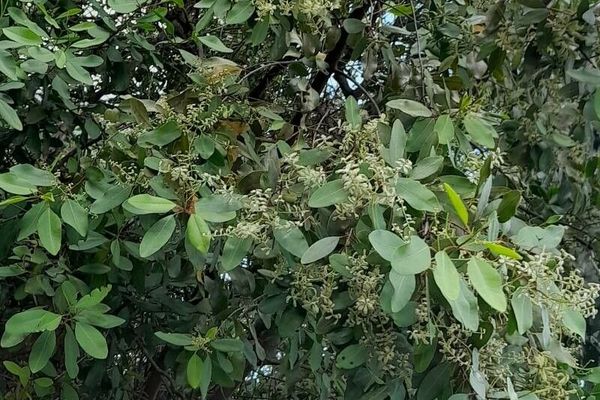
White buttonwood
Laguncularia racemosa
Родина: Combretaceae • Рід: Laguncularia
БагаторічнаСередньоДекоративна
White Mangrove is the most frost-sensitive of the three Florida mangrove species, typically occupying the landward fringe of the mangrove forest on slightly higher ground that is less frequently inundated than the zones occupied by Red and Black Mangrove. Distinguished by its pale, yellowish-gray ba
Опис
White Mangrove is the most frost-sensitive of the three Florida mangrove species, typically occupying the landward fringe of the mangrove forest on slightly higher ground that is less frequently inundated than the zones occupied by Red and Black Mangrove. Distinguished by its pale, yellowish-gray bark and distinctive pairs of salt-excreting glands (nectaries) at the base of each leaf, White Mangrove lacks the dramatic prop roots of Red Mangrove and the pneumatophore air-root mats of Black Mangrove, though small peg-like root structures occasionally develop in waterlogged conditions. The flowers attract native bees and produce nectar, and the dense canopy provides critical nesting habitat for ibis, egrets, herons, and spoonbills in Florida's coastal rookeries. Restricted to frost-free Zone 10–11 coastal settings in the United States, White Mangrove is protected under Florida law and should only be planted from nursery stock within the appropriate coastal habitat.
Спосіб посадки: Висадка розсади
Відстань між рослинами: 96–180 дюймів
Висота: 180–360 дюймів
Дні до схожості: 7–21
Температура ґрунту для схожості: 21–29°C
Походження та ареал
Відомий як: white mangrove
Поради
White Mangrove is the most frost-sensitive of the three Florida mangrove species, typically occupying the landward fringe of the mangrove forest on slightly higher ground that is less frequently inundated than the zones occupied by Red and Black Mangrove. Distinguished by its pale, yellowish-gray bark and distinctive pairs of salt-excreting glands (nectaries) at the base of each leaf, White Mangrove lacks the dramatic prop roots of Red Mangrove and the pneumatophore air-root mats of Black Mangrove, though small peg-like root structures occasionally develop in waterlogged conditions. The flowers attract native bees and produce nectar, and the dense canopy provides critical nesting habitat for ibis, egrets, herons, and spoonbills in Florida's coastal rookeries. Restricted to frost-free Zone 10–11 coastal settings in the United States, White Mangrove is protected under Florida law and should only be planted from nursery stock within the appropriate coastal habitat.
Спосіб посадки: Висадка розсади
Відстань між рослинами: 96–180 дюймів
Висота: 180–360 дюймів
Дні до схожості: 7–21
Температура ґрунту для схожості: 21–29°C
---
Час посадки: 0–8 тижнів spring
Plant nursery-grown stock in spring in sheltered coastal, estuarine, or tidal sites in full sun in Zone 10–11. White Mangrove typically occupies slightly higher, less frequently flooded ground than Red Mangrove. The seeds germinate rapidly after dropping; propagules should be planted immediately in appropriate coastal substrate. Never plant outside of natural range.