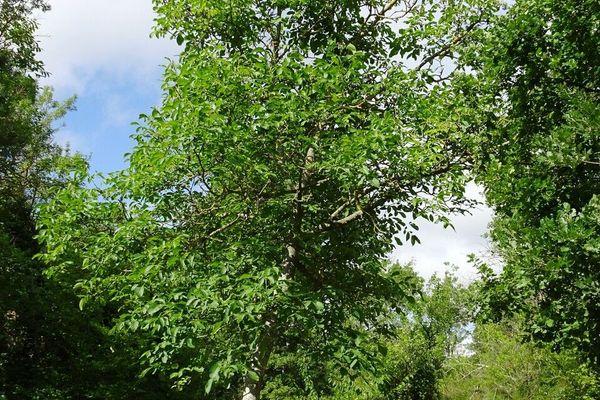
Опис
Global Crop Management: Standard Other Systems: Irreg. Intercrop Other Systems: Strip intercrop Staple Crop: Protein-oil Landscape Uses:Aggressive surface roots possible, Specimen. Requires a deep well-drained loam and a sunny position sheltered from strong winds. Prefers a slightly alkaline heavy loam but succeeds in most soils[1, 63]. The walnut tree is reported to tolerate an annual precipitation of 31 to 147cm, an annual temperature in the range of 7.0 to 21.1°C and a pH in the range of 4.5 to 8.2. The dormant plant is very cold tolerant, tolerating temperatures down to about -27°C without serious damage, but the young spring growth is rather tender and can be damaged by late frosts. Some late-leafing cultivars have been developed, these often avoid damage from spring frosts and can produce a better quality timber tree. The walnut tree is frequently cultivated for its edible seed in temperate zones of the world, there are many named varieties[63, 183]. Newer cultivars begin producing nuts in 5 - 6 years; by 7 - 8 years, they produce about 2.5 tons of nuts per hectare. Orchards on relatively poor, unirrigated mountain soil report 1.5 - 2.25 tonnes per hectare, orchards in well cultivated valleys, 6.5 - 7.5 tonnes per hectare. According to the Wealth of India, a fully grown individual can yield about 185 kg, but 37 kg is more likely. Trees grow well in most areas of Britain but they often fail to fully ripen their fruits or their wood in our cooler and damper climate[63, 200], they prefer a more continental climate. There are some very fine trees in Cornwall. Walnuts can produce large healthy trees in many parts of Britain, but seedling trees often do not fruit reliably. Some European varieties have been developed that succeed in colder areas. Seedling trees are said to take from 6 to 15 years to come into fruit from seed, but these cultivars usually start cropping within 5 years. Plants produce a deep taproot and they are intolerant of root disturbance. Seedlings should be planted out into their permanent positions as soon as possible and given some protection for their first winter or two since they are somewhat tender when young. Flower initiation depends upon suitable conditions in the previous summer. The flowers and young growths can be destroyed by even short periods down to -2°c, but fortunately plants are usually late coming into leaf. Some cultivars are self-fertile, though it is generally best to grow at least two different cultivars to assist in cross-pollination. Any pruning should only be carried out in late summer to early autumn or when the plant is fully dormant otherwise wounds will bleed profusely and this will severely weaken the tree. Plants produce chemicals which can inhibit the growth of other plants. These chemicals are dissolved out of the leaves when it rains and are washed down to the ground below, reducing the growth of plants under the tree[18, 20, 159]. The roots also produce substances that are toxic to many plant species, especially apples (Malus species), members of the Ericaceae, Potentilla spp and the white pines (certain Pinus spp.). Trees have a dense canopy which tends to reduce plant growth below them. All in all, not the best of companion trees, it is also suggested that the trees do not like growing together in clumps. Trees are said to inhibit the growth of potatoes and tomatoes. Hybridizes with J. nigra. This species is notably susceptible to honey fungus. The bruised leaves have a pleasant sweet though resinous smell. Special Features: Not North American native, Inconspicuous flowers or blooms. The plant is heat tolerant in zones 7 through 1. (Plant Hardiness Zones show how well plants withstand cold winter temperatures. Plant Heat Zones show when plants would start suffering from the heat. The Plant Heat Zone map is based on the number of "heat days" experienced in a given area where the temperature climbs to over 86 degrees F (30°C). At this temperature, many plants begin to suffer physiological damage. Heat Zones range from 1 (no heat days) to 12 (210 or more heat days). For example Heat Zone. 11-1 indicates that the plant is heat tolerant in zones 11 through 1.) For polyculture design as well as the above-ground architecture (form - tree, shrub etc. and size shown above) information on the habit and root pattern is also useful and given here if available. The plant growth habit is a standard with a non-suckering single trunk [1-2]. Walnuts are usually harvested in autumn when the husks begin to split and turn brown. Walnuts generally flower in spring producing long catkins for male flowers and clusters for female flowers. Walnuts are moderate to fast-growing trees, typically reaching maturity in about 10 to 15 years, depending on the species and growing conditions. Carbon Farming Global Crop These crops are already grown or traded around the world. The annual value of each is more than $1 billion US Examples include coconuts, almonds, and bananas. Managemen
Походження та ареал
TEMPERATE ASIA: Azerbaijan, Iran (north & west), Iraq (north), Tajikistan, Turkey, Turkmenistan,Afghanistan. TROPICAL ASIA: Pakistan (north), EUROPE: Czech Republic, Slovakia, Bulgaria, Bosnia and Herzegovina, Greece, Croatia, North Macedonia, Montenegro, Serbia, Slovenia,
Корисні властивості
Edible Parts: Oil Oil Sap Seed Edible Uses: Oil Oil Sweetener Tea Seed - eaten raw or used in confections, cakes, ice cream etc[2, 5, 12, 34, 183]. A delicious flavour. The seed can also be ground into a meal and used as a flavouring in sweet and savoury dishes. The unripe fruits are pickled in vinegar. An edible oil is obtained from the seed[4, 7, 57, 183], it should not be stored for any length of time since it tends to go rancid quickly[7, 132]. The oil has a pleasant flavour and is used in salads or for cooking. The sap is tapped in spring and used to make a sugar. The finely ground shells are used in the stuffing of 'agnolotti' pasta. They have also been used as adulterant of spices. The dried green husks contain 2.5 - 5% ascorbic acid (vitamin C) - this can be extracted and used as a vitamin supplement. The leaves are used as a tea. References More on Edible Uses
Поради
The seed is best sown as soon as it is ripe in individual deep pots in a cold frame. You need to protect it from mice, birds, squirrels etc. The seed usually germinates in late winter or the spring. Plant out the seedlings into their permanent positions in early summer and give some protection from the cold for their first winter or two. The seed can also be stored in cool moist conditions (such s the salad compartment of a fridge) over the winter and sown in early spring but it may then require a period of cold stratification before it will germinate[78, 80, 113]. Named varieties are propagated by budding.