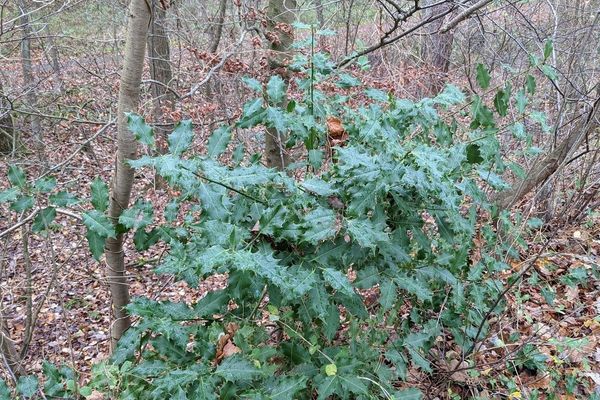
English holly
Ilex aquifolium
Родина: Aquifoliaceae • Рід: Ilex
БагаторічнаСередньоДекоративна
Bloom Color: Green, White. Main Bloom Time: Early spring, Late spring, Mid spring. Form: Pyramidal.
Опис
Succeeds in most soils, including peat, chalk, gravels, sand and shales, so long as they are not water-logged, though wild plants are occasionally found in situations with standing winter water. Grows well in heavy clay soils. Established plants are fairly drought tolerant. Dislikes dry soils according to one report whilst another says that it succeeds in dry shade. Tolerates a pH range from 3.5 to 7.2. Succeeds in full sun or fairly dense shade[17, 28, 31], self-sown seedlings from woods and shady places making the most shade tolerant plants. Tolerant of maritime exposure though in such a situation it may lose some or all its leaves in the winter. Plants require a minimum July temperature of 12°c for good fruit production. They tolerate short periods in winter down to -15°c. Severe frosts can kill whole branches, especially if they are open to the sky. The young growth in spring can be damaged by late frosts. A very ornamental plant, there are many named varieties. Flowers and fruits are formed on wood of the previous year's growth. A good bee plant, the minute flowers are sweetly scented. The fruit is a valuable winter food source for birds. Resents root disturbance, especially as the plants get older. It is best to place the plants into their permanent positions as soon as possible, perhaps giving some winter protection for their first year or two[K]. Only move the plants in May or, preferably, in September. Plants are quite slow growing, even when in good soils and situations[11, 75]. Trees are usually dioecious but hermaphrodite forms are available. Male and female plants must usually be grown if seed is required. Plants are capable of regenerating from the main stem both above and below ground level and, although the top may be killed in a fire, the plants will usually regrow from the base. Rabbits are particularly fond of this species and will quickly remove the bark. This species is notably resistant to honey fungus. Special Features: Attractive foliage, Not North American native, Naturalizing, Fragrant flowers, Inconspicuous flowers or blooms. In garden design, as well as the above-ground architecture of a plant, root structure considerations help in choosing plants that work together for their optimal soil requirements including nutrients and water. The root pattern is branching: a heart root, dividing from the crown into several primary roots going down and out [2-1]. References Carbon Farming Information and Carbon Sequestration Information Temperature Converter Type a value in the Celsius field to convert the value to Fahrenheit: Celsius Fahrenheit: The PFAF Bookshop Plants For A Future have a number of books available in paperback and digital form. Book titles include Edible Plants , Edible Perennials , Edible Trees , Edible Shrubs , Woodland Gardening , and Temperate Food Forest Plants . Our new book is Food Forest Plants For Hotter Conditions (Tropical and Sub-Tropical) . Shop Now
Походження та ареал
TEMPERATE ASIA: Iran, Lebanon, Syria, Turkey EUROPE: United Kingdom, Albania, Bulgaria, Bosnia and Herzegovina, Croatia, Italy, North Macedonia, Montenegro, Serbia, Slovenia, Spain, France, Portugal AFRICA: Algeria, Morocco, Tunisia
Корисні властивості
Edible Parts: Edible Uses: Tea The leaves have been used as a tea substitute. The roasted fruit has been used as a coffee substitute. Some caution is advised here, since the fruit can be purgative and emetic[K]. References More on Edible Uses
Поради
Seed - best sown as soon as it is ripe in the autumn in a cold frame. It can take 18 months to germinate. Stored seed generally requires two winters and a summer before it will germinate and should be sown as soon as possible in a cold frame. Scarification, followed by a warm stratification and then a cold stratification may speed up the germination time[78, 80]. The seedlings are rather slow-growing. Pot them up into individual pots when they are large enough to handle and grow them on in light shade in a cold frame for their first year. It is possible to plant them out into a nursery bed in late spring of the following year, but they should not be left here for more than two years since they do not like being transplanted. Alternatively, grow them on in their pots for a second season and then plant them out into their permanent positions in late spring or early summer. Give them a good mulch and some protection for their first winter outdoors. Cuttings of almost ripe wood with a heel, August in a shaded position in a cold frame. Leave for 12 months before potting up. Layering in October. Takes 2 years.