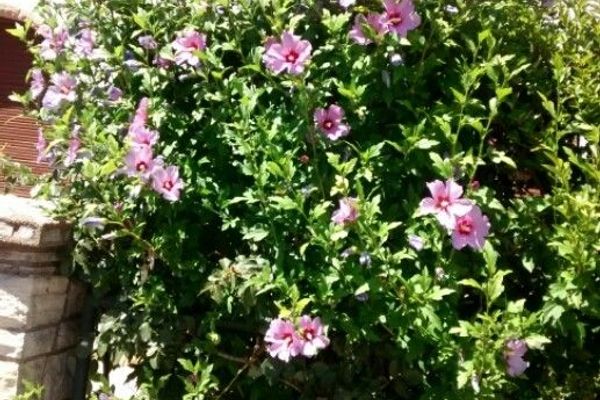
Rose-of-sharon
Hibiscus syriacus
Родина: Malvaceae • Рід: Hibiscus
БагаторічнаСередньоДекоративна
Taxonomic Note: This genus was formerly classified in the family Tiliaceae. Modern classifications include it within the Malvaceae. Bloom Color: Blue, Lavender, Pink, Purple, Red, White. Main Bloom Time: Early summer, Late summer, Mid summer. Form: Rounded, Upright or erect.
Опис
Landscape Uses:Border, Container, Foundation, Standard, Seashore, Specimen. Prefers a well-drained humus rich fertile soil in a sheltered position in full sun. Succeeds in any soil of good or moderate quality. Dislikes shade or badly drained soils. Plants grow best with their roots in cool moist soil and their tops in a hot sunny position. This species is hardy to about -20°c but plants only really succeed in the warmer counties of Britain because of their late flowering habit. When planted in colder areas of the country, they will need protection for the first few winters. The flowers only open in sunny weather. Plants rarely require pruning, though they respond well to pruning and trimming and this is best carried out in the spring or just after flowering. Plants are late coming into leaf, usually around the end of May or early June. A very ornamental plant, there are many named varieties. Special Features:Attracts birds, Not North American native, Naturalizing, Attracts butterflies, Blooms are very showy. The plant is heat tolerant in zones 9 through 1. (Plant Hardiness Zones show how well plants withstand cold winter temperatures. Plant Heat Zones show when plants would start suffering from the heat. The Plant Heat Zone map is based on the number of "heat days" experienced in a given area where the temperature climbs to over 86 degrees F (30°C). At this temperature, many plants begin to suffer physiological damage. Heat Zones range from 1 (no heat days) to 12 (210 or more heat days). For example Heat Zone. 11-1 indicates that the plant is heat tolerant in zones 11 through 1.) For polyculture design as well as the above-ground architecture (form - tree, shrub etc. and size shown above) information on the habit and root pattern is also useful and given here if available. The plant growth habit is multistemmed with multiple stems from the crown [1-2]. References Carbon Farming Information and Carbon Sequestration Information Temperature Converter Type a value in the Celsius field to convert the value to Fahrenheit: Celsius Fahrenheit: The PFAF Bookshop Plants For A Future have a number of books available in paperback and digital form. Book titles include Edible Plants , Edible Perennials , Edible Trees , Edible Shrubs , Woodland Gardening , and Temperate Food Forest Plants . Our new book is Food Forest Plants For Hotter Conditions (Tropical and Sub-Tropical) . Shop Now
Походження та ареал
TEMPERATE ASIA: Anhui Sheng, Fujian Sheng, Guangdong Sheng, Guangxi Zhuangzu Zizhiqu, Guizhou Sheng, Hebei Sheng, Henan Sheng, Hubei Sheng, Hunan Sheng, Jiangsu Sheng, Jiangxi Sheng, Shaanxi Sheng, Shandong Sheng, Sichuan Sheng, Taiwan, Yunnan Sheng, Zhejiang Sheng,China.
Корисні властивості
Edible Parts: Flowers Leaves Oil Root Edible Uses: Oil Tea Young leaves - raw or cooked[2, 177, 179, 183]. A very mild flavour, though slightly on the tough side, they make an acceptable addition to the salad bowl[K]. A tea is made from the leaves[2, 177, 240] or the flowers. Flowers - raw or cooked[74, 105, 183]. A mild flavour and mucilaginous texture, they are delightful in salads, both for looking at and for eating[K]. Root - it is edible but very fibrousy. Mucilaginous, without very much flavour. References More on Edible Uses
Поради
Seed - sow early spring in a greenhouse. Germination is usually fairly quick. Prick out the seedlings into individual pots when they are large enough to handle and grow them on in the greenhouse for their first year. Plant them out into their permanent positions in late spring or early summer. Some reports say that the seed can be sown in situ outside and that it gives a good rate of germination[78, 80, 113]. Cuttings of half-ripe wood, July/August in a frame. Good percentage. Cuttings of mature wood, early autumn in a frame. Good percentage. Layering in mid summer to early autumn.