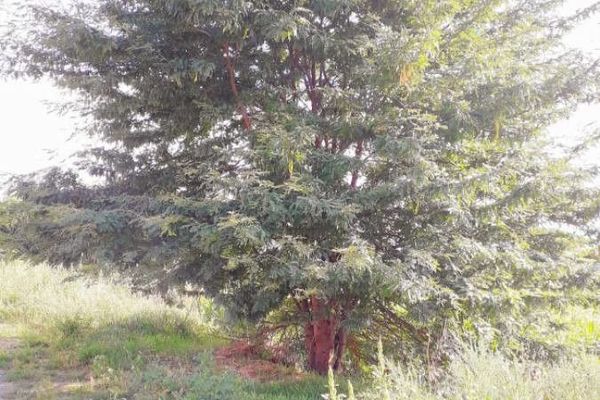
Three-thorn-acacia
Gleditsia triacanthos
Родина: Fabaceae • Рід: Gleditsia
БагаторічнаСередньоДекоративна
Bloom Color: Yellow. Main Bloom Time: Early spring, Late spring, Mid spring. Form: Oval, Rounded.
Опис
Agroforestry Services: Living fence Fodder: Bank Fodder: Pod Industrial Crop: Biomass Management: Coppice Management: Standard Minor Global Crop Staple Crop: Balanced carb Landscape Uses:Aggressive surface roots possible, Specimen. Succeeds in most soils, acid or alkaline[160, 200], so long as they are well-drained. Requires a sunny position. Tolerates drought once established and atmospheric pollution. Salt tolerant. The honey locust is speculated to tolerate an annual precipitation of 60 to 150cm, an annual temperature range of 10 to 21°C, and a pH in the range of 6 to 8. Trees are rather tender when young, but they are hardy to about -30°c once they are established. They grow best in southern Britain. The honey locust is often cultivated in warm temperate zones for its edible seeds and seedpods, trees start to bear when about 10 years old and produce commercial crops for about 100 years. Wild trees seldom live longer than 120 years. Trees are shy to flower and therefore do not often produce a worthwhile crop in Britain due to our cooler summers. There are some named varieties. The sub-species nana produced lots of viable seed in the hot summer of 1989 at Kew[K], it also had a very good crop in 1994, 1996 and in 1999[K]. The sub-species inermis had a very good crop of pods in the autumn of 1996[K]. 'Ashworth' has pods with a very sweet pulp that has a melon-like flavour. The flowers have a pleasing scent. A very ornamental tree, the flowers are very attractive to bees[149, 269]. Trees have a light canopy, they come into leaf late and lose their leaves early making them an excellent canopy tree for a woodland garden. Plants in this genus are notably resistant to honey fungus. Unlike most plants in this family, honey locusts do not fix atmospheric nitrogen[160, 226]. Special Features:North American native, Naturalizing, Fragrant flowers, Inconspicuous flowers or blooms. The plant is heat tolerant in zones 7 through 1. (Plant Hardiness Zones show how well plants withstand cold winter temperatures. Plant Heat Zones show when plants would start suffering from the heat. The Plant Heat Zone map is based on the number of "heat days" experienced in a given area where the temperature climbs to over 86 degrees F (30°C). At this temperature, many plants begin to suffer physiological damage. Heat Zones range from 1 (no heat days) to 12 (210 or more heat days). For example Heat Zone. 11-1 indicates that the plant is heat tolerant in zones 11 through 1.) For polyculture design as well as the above-ground architecture (form - tree, shrub etc. and size shown above) information on the habit and root pattern is also useful and given here if available. The plant growth habit is a standard with a non-suckering single trunk [1-2]. The root pattern is flat with shallow roots forming a plate near the soil surface [1-2]. The root pattern is a heart root, dividing from the crown into several primary roots going down and out [1-2]. The root pattern is a tap root similar to a carrot going directly down [1-2]. Carbon Farming Agroforestry Services: Living fence Simply managed rows of shrubs and trees. Fodder: Bank Fodder banks are plantings of high-quality fodder species. Their goal is to maintain healthy productive animals. They can be utilized all year, but are designed to bridge the forage scarcity of annual dry seasons. Fodder bank plants are usually trees or shrubs, and often legumes. The relatively deep roots of these woody perennials allow them to reach soil nutrients and moisture not available to grasses and herbaceous plants. Fodder: Pod Fodder plants with pods. Industrial Crop: Biomass Three broad categories: bamboos, resprouting woody plants, and giant grasses. uses include: protein, materials (paper, building materials, fibers, biochar etc.), chemicals (biobased chemicals), energy - biofuels Management: Coppice Cut to the ground repeatedly - resprouting vigorously. Non-destructive management systems maintaining the soil organic carbon. Management: Standard Plants grow to their standard height. Harvest fruit, seeds, or other products. Non-Destructive management systems. Minor Global Crop These crops are already grown or traded around the world, but on a smaller scale than the global perennial staple and industrial crops, The annual value of a minor global crop is under $1 billion US. Examples include shea, carob, Brazil nuts and fibers such as ramie and sisal. Staple Crop: Balanced carb (0-15 percent protein, 0-15 percent oil, with at least one over 5 percent). The carbohydrates are from either starch or sugar. Annuals include maize, wheat, rice, and potato. Perennials include chestnuts, carob, perennial fruits, nuts, cereals, pseudocereals, woody pods, and acorns. References Carbon Farming Information and Carbon Sequestration Information Temperature Converter Type a value in the Celsius field to convert the value to Fahrenheit: Celsius Fahrenheit: The PFAF Bookshop Plants For A Future have a number of books available in pa
Походження та ареал
NORTHERN AMERICA: Canada, Ontario, United States, Indiana, Michigan (south), Pennsylvania, Illinois, Iowa, Kansas, Minnesota (southeast), Missouri, Nebraska, Oklahoma, South Dakota (southeast), Wisconsin, Alabama, Arkansas, Florida, Georgia, Kentucky, Louisiana, Maryland (west), Mississippi, North Carolina (west), South Carolina, Tennessee, Virginia (southwest), Texas,
Корисні властивості
Edible Parts: Seed Seedpod Edible Uses: Coffee Drink Gum Sweetener Seed - raw or cooked. It can contain up to 30% sugar. Young seeds taste like raw peas. Seeds are not always borne in maritime regions because the tree prefers long hot summers. The oval seeds are about 8mm long. They contain 10.6 - 24.1% protein, 0.8 - 4.3% fat, 84.7% carbohydrate, 21.1% fibre, 4% ash, 280mg calcium and 320mg phosphorus per 100g. The seeds have been roasted and used as a coffee substitute. Seedpods - the pulp is sweet and can be eaten raw or made into sugar[149, 159, 183]. The render young seedpods can be cooked and eaten. The pulp in older pods turns bitter. The seedpods are up to 40cm long and 4cm wide. A sweet, pleasant tasting drink can be made from the seed pods. The seed pulp has been used to make a drink. References More on Edible Uses
Поради
Seed - pre-soak for 24 hours in warm water and then sow in spring in a greenhouse. The seed should have swollen up, in which case it can be sown, if it has not swollen then soak it for another 24 hours in warm water. If this does not work then file away some of the seed coat but be careful not to damage the embryo. Further soaking should then cause the seed to swell. One it has swollen, the seed should germinate within 2 - 4 weeks at 20°c. As soon as they are large enough to handle, prick the seedlings out into individual deep pots and plant them out into their permanent positions in the summer. Give the plants some protection from the cold for their first few winters outdoors.