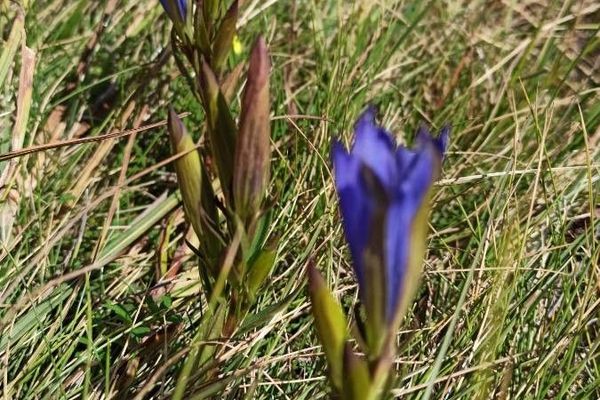
Marsh gentian
Gentiana pneumonanthe
Родина: Gentianaceae • Рід: Gentiana
БагаторічнаСередньоДекоративна
вид рослин
Опис
In general, gentians require a moist well-drained soil in a sheltered position, a certain minimum of atmospheric humidity, high light intensity but a site where temperatures are not too high. They are therefore more difficult to grow in areas with hot summers and in such a region they appreciate some protection from the strongest sunlight[200, 239]. Most species will grow well in the rock garden. This species is calcifuge and requires a humus-rich lime-free soil[1, 50, 239]. It is not very easy to cultivate and is not very long-lived. A moisture loving plant, preferring to grow with full exposure to the sun but with plenty of underground moisture in the summer, it grows better in the north and west of Britain. A very ornamental plant. Plants are intolerant of root disturbance and should be placed in their final positions as soon as possible. References Carbon Farming Information and Carbon Sequestration Information Temperature Converter Type a value in the Celsius field to convert the value to Fahrenheit: Celsius Fahrenheit: The PFAF Bookshop Plants For A Future have a number of books available in paperback and digital form. Book titles include Edible Plants , Edible Perennials , Edible Trees , Edible Shrubs , Woodland Gardening , and Temperate Food Forest Plants . Our new book is Food Forest Plants For Hotter Conditions (Tropical and Sub-Tropical) . Shop Now
Походження та ареал
TEMPERATE ASIA: Russian Federation-Ciscaucasia (Ciscaucasia), Georgia, Russian Federation (Altay, Krasnoyarsk, Kemerovskaja oblast, Kurganskaja oblast, Novosibirsk, Omsk, Tomsk, Tyumen (south)) EUROPE: Denmark, United Kingdom, Norway, Sweden, Austria, Belgium, Switzerland, Czech Republic, Germany, Hungary, Netherlands, Poland, Slovakia, Russian Federation (European part), Belarus, Estonia, Lithuania, Latvia, Moldova, Ukraine, Albania, Bulgaria, Bosnia and Herzegovina, Croatia, Italy, Romania, Se
Корисні властивості
None known References More on Edible Uses
Поради
Seed - best sown as soon as it is ripe in a light position in a cold frame. It requires an acid humus-rich compost and should not be allowed to dry out. The seed can also be sown in late winter or early spring but the seed germinates best if given a period of cold stratification and quickly loses viability when stored, with older seed germinating slowly and erratically[200, 239]. It is advantageous to keep the seed at about 10°c for a few days after sowing, to enable the seed to imbibe moisture. Following this with a period of at least 5 - 6 weeks with temperatures falling to between 0 and -5°c will usually produce reasonable germination. It is best to use clay pots, since plastic ones do not drain so freely and the moister conditions encourage the growth of moss, which will prevent germination of the seed. The seed should be surface-sown, or only covered with a very light dressing of compost. The seed requires dark for germination, so the pots should be covered with something like newspaper or be kept in the dark. Pot up the seedlings into individual pots as soon as they are large enough to handle and grow on in light shade in the greenhouse for at least their first winter. The seedlings usually flower in their second year. When the plants are of sufficient size, place them out into their permanent positions in late spring or early summer. Division in March. Most members of this genus have either a single tap-root, or a compact root system united in a single root head, and are thus unsuitable for division. Cuttings of basal shoots in late spring.