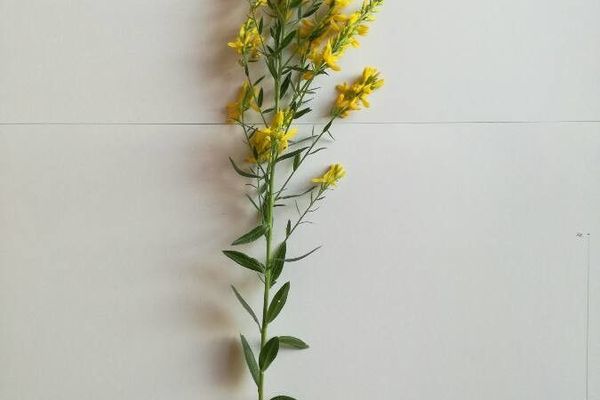
Dyer's broom
Genista tinctoria
Родина: Fabaceae • Рід: Genista
БагаторічнаСередньоДекоративна
Bloom Color: Yellow. Main Bloom Time: Early summer, Late summer, Mid summer. Form: Oval, Upright or erect.
Опис
Landscape Uses:Border, Container, Erosion control, Foundation, Massing, Specimen. Easily grown in a light well-drained soil in a sunny position[1, 11]. Prefers a rather dry soil, tolerating poor and sandy soils. Prefers a lime-free soil. Succeeds in acid or basic soils. A very cold-tolerant plant, tolerating temperatures down to about -35°c. Resents root disturbance and should only be transplanted whilst young[11, 169]. Sometimes cultivated as a dye plant, it is usually treated as a biennial for this purpose, the whole plant being harvested in the second year. Plants do not require pruning, but they can be cut back as required once they have finished flowering in order to maintain shape. Polymorphic, a number of named forms have been developed for their ornamental value. A good bee plant. Rabbits love eating this plant[169, K]. Cows also eat the plant, but it taints their milk. This species has a symbiotic relationship with certain soil bacteria, these bacteria form nodules on the roots and fix atmospheric nitrogen. Some of this nitrogen is utilized by the growing plant but some can also be used by other plants growing nearby. Special Features:Not North American native, Attractive flowers or blooms. The plant is heat tolerant in zones 8 through 1. (Plant Hardiness Zones show how well plants withstand cold winter temperatures. Plant Heat Zones show when plants would start suffering from the heat. The Plant Heat Zone map is based on the number of "heat days" experienced in a given area where the temperature climbs to over 86 degrees F (30°C). At this temperature, many plants begin to suffer physiological damage. Heat Zones range from 1 (no heat days) to 12 (210 or more heat days). For example Heat Zone. 11-1 indicates that the plant is heat tolerant in zones 11 through 1.) For polyculture design as well as the above-ground architecture (form - tree, shrub etc. and size shown above) information on the habit and root pattern is also useful and given here if available. The plant growth habit is multistemmed with multiple stems from the crown [1-2]. References Carbon Farming Information and Carbon Sequestration Information Temperature Converter Type a value in the Celsius field to convert the value to Fahrenheit: Celsius Fahrenheit: The PFAF Bookshop Plants For A Future have a number of books available in paperback and digital form. Book titles include Edible Plants , Edible Perennials , Edible Trees , Edible Shrubs , Woodland Gardening , and Temperate Food Forest Plants . Our new book is Food Forest Plants For Hotter Conditions (Tropical and Sub-Tropical) . Shop Now
Походження та ареал
TEMPERATE ASIA: Iran (northwest), Kazakhstan, Russian Federation-Western, Siberia, Turkey (north), Western Siberia,Afghanistan. EUROPE: Denmark, United Kingdom (U.K.), Norway, Sweden, Czechoslovakia (Czech Republic and Slovakia), Austria, Belgium, Switzerland, Germany, Hungary, Netherlands, Poland, Russian Federation-European part, European part, Belarus, Lithuania, Moldova, Ukraine, Former Yugoslavia, Albania, Bulgaria, Greece, Italy, Romania, Spain, France,
Корисні властивості
Edible Parts: Leaves Edible Uses: Coffee Condiment The seed has been suggested as a possible coffee substitute[177, 183]. The flower buds are pickled and used as a substitute for capers[2, 183]. Used as a vegetable. References More on Edible Uses
Поради
The seed requires a period of cold stratification and is best sown autumn in a cold frame. Pre-soak stored seed for 24 hours in warm water and sow February in a cold frame. Good germination. When they are large enough to handle, prick the seedlings out into individual pots and plant them out in the summer. Cuttings of half-ripe wood, 5 - 10 cm with a heel, July/August in a frame. Roots are formed in the spring. Cuttings of ripe wood, 5 - 10 cm with a heel, September/October in a frame. Good percentage. Plant out the following autumn.