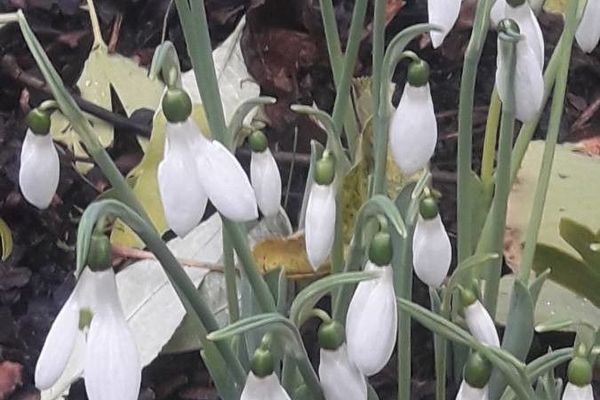
Common snowdrop
Galanthus nivalis
Родина: Amaryllidaceae • Рід: Galanthus
БагаторічнаСередньоДекоративна
Taxonomic Note: This genus was formerly classified in the family Alliaceae. Modern classifications include it within the Amaryllidaceae. Bloom Color: White. Main Bloom Time: Early spring, Late winter, Mid winter. Form: Upright or erect.
Опис
Landscape Uses:Alpine garden, Border, Container, Foundation, Massing, Rock garden, Woodland garden. Prefers a moist heavy loam, growing well in grass or amongst shrubs. Prefers a shady position[28, 31]. The dormant bulbs are fairly hardy and will withstand soil temperatures down to at least -5°c. A very ornamental plant, it grows well on the woodland edge. The bulbs should be planted about 5 - 7cm deep as early in the spring as possible. A good bee plant, providing an early source of pollen and nectar. Special Features:Not North American native, Naturalizing, All or parts of this plant are poisonous, Fragrant flowers. References Carbon Farming Information and Carbon Sequestration Information Temperature Converter Type a value in the Celsius field to convert the value to Fahrenheit: Celsius Fahrenheit: The PFAF Bookshop Plants For A Future have a number of books available in paperback and digital form. Book titles include Edible Plants , Edible Perennials , Edible Trees , Edible Shrubs , Woodland Gardening , and Temperate Food Forest Plants . Our new book is Food Forest Plants For Hotter Conditions (Tropical and Sub-Tropical) . Shop Now
Походження та ареал
TEMPERATE ASIA: Russian Federation-Ciscaucasia (Ciscaucasia) EUROPE: Austria, Switzerland, Czech Republic, Germany, Hungary, Poland, Slovakia, Moldova, Ukraine, Former Yugoslavia, Albania, Bulgaria, Greece (n. & Kastellorizo Island), Italy (incl. Sicily), Romania, Turkey (Istanbul), Spain (northeast), France
Корисні властивості
None known References More on Edible Uses
Поради
Seed - best sown as soon as it is ripe in a cold frame. Sow the seed thinly so that there is no need to thin them. The seed usually germinates in the spring. Grow them on in the same pot in a cold frame for the first two years, giving an occasional liquid feed to ensure the plants do not become nutrient deficient. Pot up the small bulbs whilst they are still in leaf in early summer of their second year's growth, putting about 3 bulbs in each pot. Grow them on in the cold frame for a further year before planting them out into their permanent positions in late spring whilst they are still in growth. The plants take about 4 years to flower from seed. Division of offsets[1, 200]. This is best done immediately after the plants have finished flowering (and still have green leaves) though it can also be done in late summer and early autumn when the plants are dormant. Scooping.