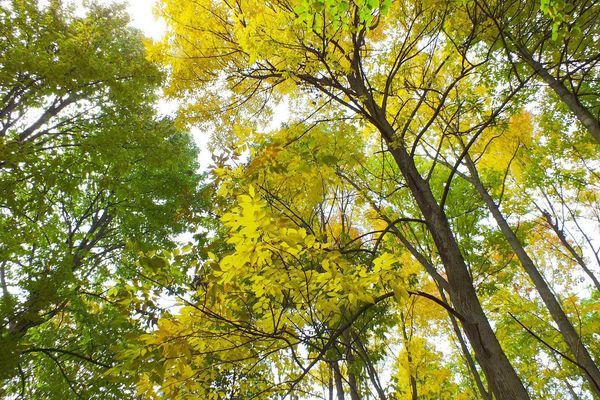
Green ash
Fraxinus pennsylvanica
Родина: Oleaceae • Рід: Fraxinus
БагаторічнаСередньоДекоративна
Bloom Color: Green. Main Bloom Time: Early spring, Late spring, Mid spring. Form: Oval, Upright or erect.
Опис
Prefers deep loamy soil, even if it is on the heavy side[1, 200]. Fraxinus pennsylvanica tolerates a broad range of temperatures and precipitation and is probably the most adaptable of all the ash species[338 ]. It is a very cold-hardy plant, able to tolerate temperatures down to around -30°c when fully dormant[200 ] Prefers a deep loamy soil, even if it is on the heavy side[1 , 200 ]. Most members of this genus are gross feeders and require a rich soil[11 , 200 ]. Plants succeed when growing in exposed positions[200 ] and also in alkaline soils[11 ]. They tolerate atmospheric pollution[200 ]. A fast-growing tree[188 ]. Plants have little tolerance of shade[226 ]. Cultivated as a timber tree in C. and S.E. Europe where it is sometimes naturalized[50 ]. The cultivar 'Patmore' is disease resistant[188 ]. A recently introduced invasive pest, the Emerald Ash Borer has rapidly spread across much of N. America and is devastating the genus Fraxinus. The borer infests and feeds on all the North American ash species it has so far encountered. The nature of the infestation (larval feeding in the phloem) effectively girdles trees as small as 25mm in diameter, which is many years before reproductive maturity, leading to death within five years of infestation. The borer, therefore, causes virtually 100% mortality of Ash populations. The Ash species are unable to persist for very long through vegetative reproduction, and seeds only remain viable in the soil for at most 7 - 8 years, so regeneration after borer infestation is minimal or nonexistent. Furthermore, the borer persists in forests with low population densities after major ash population crashes, so the orphaned cohort of ash seedlings that remains is quickly infested as they reach a suitable size[338 ]. A dioecious species - both male and female forms must be grown if fruit and seed are required. The cultivar 'Patmore' is disease resistant. Dioecious. Male and female plants must be grown if seed is required. Special Features: North American native, Attracts butterflies, Inconspicuous flowers or blooms. References Carbon Farming Information and Carbon Sequestration Information Temperature Converter Type a value in the Celsius field to convert the value to Fahrenheit: Celsius Fahrenheit: The PFAF Bookshop Plants For A Future have a number of books available in paperback and digital form. Book titles include Edible Plants , Edible Perennials , Edible Trees , Edible Shrubs , Woodland Gardening , and Temperate Food Forest Plants . Our new book is Food Forest Plants For Hotter Conditions (Tropical and Sub-Tropical) . Shop Now
Походження та ареал
NORTHERN AMERICA: Canada (Québec (south), Nova Scotia, Ontario, New Brunswick, Saskatchewan (south), Alberta (southeast), Manitoba), United States (Connecticut, Indiana, Maine, Massachusetts, Michigan, New Hampshire, New Jersey, New York, Ohio, Pennsylvania, Rhode Island, Vermont, West Virginia, Illinois, Iowa, Kansas, Minnesota, Nebraska, North Dakota, Oklahoma, South Dakota, Wisconsin, Colorado (northeast), Montana, Wyoming (northeast), Alabama, Arkansas, Delaware, Florida (northwest), Georgia
Корисні властивості
Edible Parts: Inner bark Edible Uses: Inner bark - cooked[105, 161, 177]. The cambium layer can be scraped down in long, fluffy layers and cooked. It is said to taste like eggs. Inner bark can also be dried, ground into a powder and then used as a thickening in soups etc or mixed with cereals when making bread. References More on Edible Uses
Поради
The seed is best harvested green - as soon as it is fully developed but before it has fully dried on the tree - and can then be sown immediately in a cold frame. It usually germinates in the spring. Stored seed requires a period of cold stratification and is best sown as soon as possible in a cold frame. Prick out the seedlings into individual pots when they are large enough to handle and grow them on in a cold frame for their first winter. Plant them out into their permanent positions or a nursery bed in late spring or early summer of the following year. If you have sufficient seed then it is possible to sow it directly into an outdoor seedbed, preferably in the autumn. Grow the seedlings on in the seedbed for 2 years before transplanting either to their permanent positions or to nursery beds.